Paddle Your Own Canoe: Building a Life That Is Actually Yours
Woodworking, theatre, comedy, food, failure and a healthy amount of stubbornness. Underneath it all, one simple idea — build a life that is actually yours.
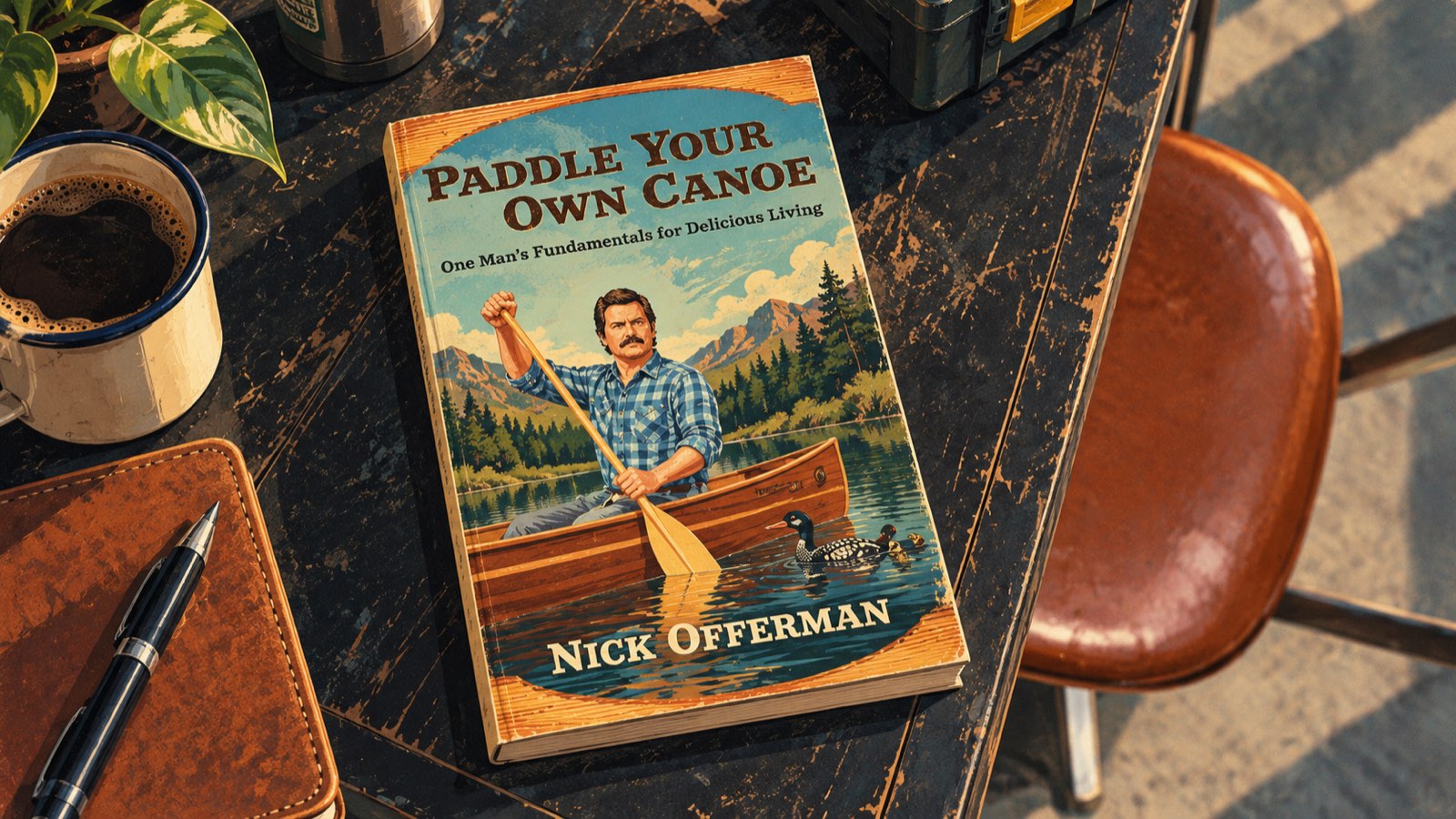
Some books tell you how to live.
Nick Offerman's Paddle Your Own Canoe feels more like sitting down with someone who has spent a lifetime figuring out how he wants to live, then listening as he explains what he has learned along the way.
There's woodworking. There's theatre. There's comedy. There's love, food, nature, hard work, failure, creativity and a healthy amount of stubbornness.
But underneath all of it is a wonderfully simple idea:
Build a life that is actually yours.
That is what stayed with me.
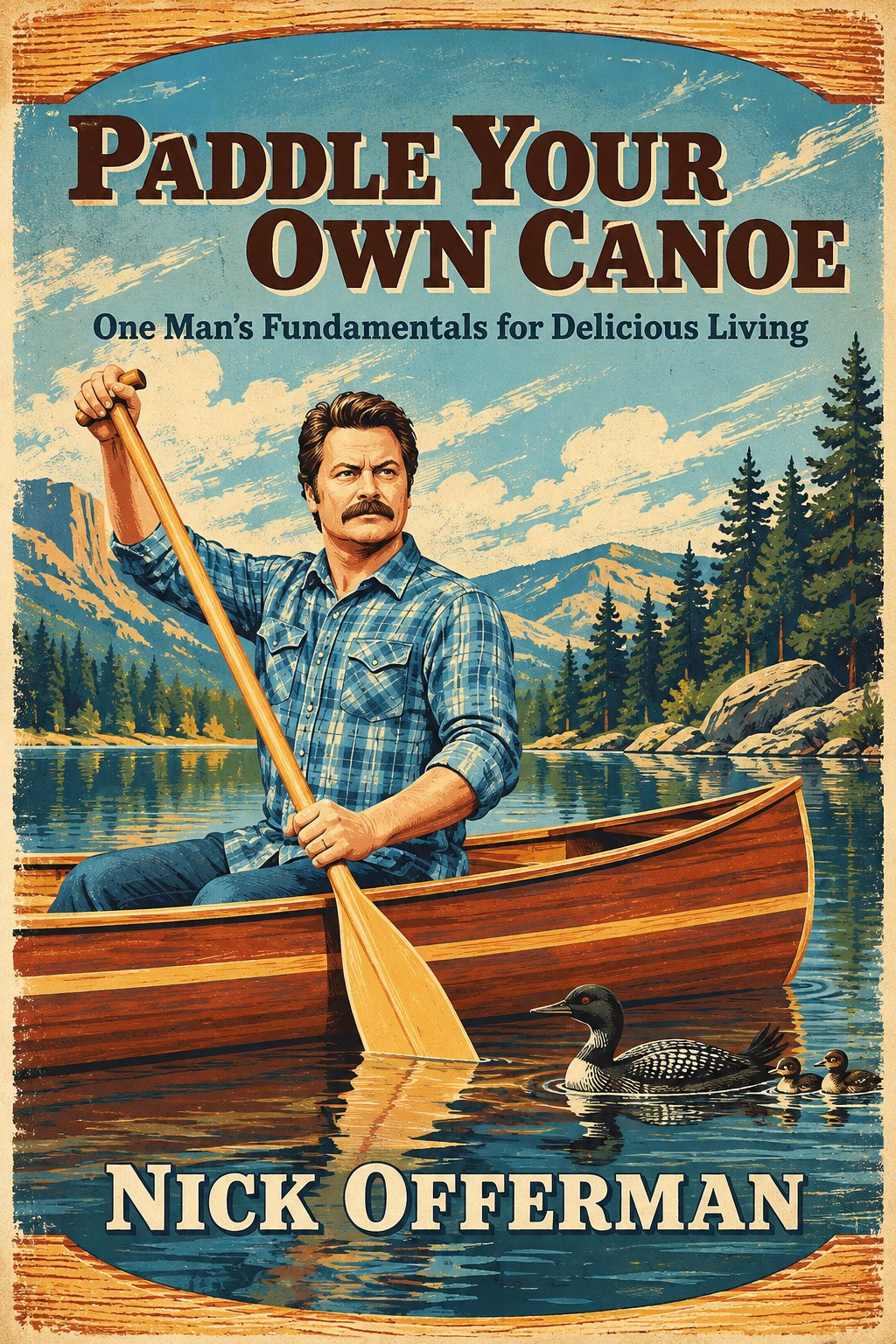
Paddle Your Own Canoe
Even the title is brilliant.
There's something beautifully physical about the idea of paddling your own canoe. You decide where you're going, but you also have to put the work in to get there.
Nobody is promising calm water.
Nobody is promising you won't accidentally steer yourself into a tree.
But the paddle is in your hands.
That idea resonates with me more and more as I get older.
My own path has hardly been a perfectly straight career trajectory. I've worked in different industries, picked up different skills, built things, fixed things, photographed things, coached people, learned networking, experimented with web development and disappeared down more technical rabbit holes than I could possibly count.
From the outside, some of those things might look completely unrelated.
To me, they're all connected by curiosity.
Paddle Your Own Canoe celebrates exactly that sort of life.
Not necessarily the conventional one.
The interesting one.
The Pleasure of Being Useful
One of the things I enjoy most about Nick Offerman's outlook is his appreciation for practical ability.
Knowing how to do something matters.
Making something with your hands.
Repairing something instead of immediately replacing it.
Cooking a proper meal.
Using a tool correctly.
Learning a craft.
Understanding the materials you're working with.
There is enormous satisfaction in competence.
And that doesn't mean you need to become a master woodworker capable of producing a walnut dining table from a suspicious-looking tree stump.
It means developing skills.
That philosophy has become a huge part of my own life.
Working in field service, I get enormous satisfaction from arriving at a machine that isn't working, investigating the problem, understanding what has happened and eventually getting it running again.
The same feeling appears when I'm building a website.
Or working on a photograph.
Or learning something about networking.
The materials change.
The tools change.
The fundamental satisfaction doesn't.
Workmanship Matters
Unsurprisingly, woodworking runs throughout Offerman's story.
But I don't think you need to care about woodworking to understand what he's really getting at.
It's about craftsmanship.
Taking pride in what you make.
Paying attention to the details nobody else might notice.
Understanding that becoming genuinely good at something takes time.
That's something I've become increasingly fascinated by.
It's one of the reasons I love tools so much.
A beautifully made screwdriver isn't interesting simply because it's a screwdriver. It's interesting because somebody thought about the shape of the handle, the material, the tip, the balance and how another human being would actually use it.
Good design is evidence that somebody cared.
And good workmanship is much the same.
Whether you're making furniture, repairing fitness equipment, writing software or building a website for a small business, there's a difference between something being finished and something being well made.
I want to aim for the second.
Put the Bloody Phone Down Occasionally
Another part of Offerman's philosophy that feels increasingly relevant is his relationship with technology.
I'm hardly going to pretend I'm anti-technology.
Quite the opposite.
I love technology.
I build websites for fun. I enjoy networking. I experiment with software. I automate things simply because I can. I'll happily spend an evening wondering whether a problem that barely exists could be solved with an unnecessarily elaborate digital system.
But there's another side to me that completely understands Offerman's affection for analogue life.
Wood.
Tools.
Books.
Mechanical things.
Photography.
Going somewhere.
Making something.
Talking to actual humans.
There's something grounding about activities that don't have a loading screen.
And perhaps that's why I enjoy combining the two worlds so much.
I don't think technology should replace craftsmanship.
Make Things
This might be the biggest lesson I take from the book.
Make things.
They don't have to be important.
They don't have to become businesses.
They don't need thousands of followers.
They don't even necessarily need to be particularly good.
Just make them.
Some of the things I've enjoyed creating most began with absolutely no grand plan.
A website.
A photograph.
An app idea.
A spreadsheet that got slightly out of hand.
A little system designed to solve an irritating problem.
One project teaches you something that unexpectedly becomes useful in another project six months later.
That's how curiosity compounds.
You learn photography and accidentally learn composition.
You learn web development and suddenly understand more about design.
You start fixing equipment and become interested in engineering.
You become interested in engineering and start thinking differently about tools.
One canoe quietly drifts into another river.
Delicious Living
And then there's that wonderful subtitle:
One Man's Fundamentals for Delicious Living.
Delicious living.
I love that phrase.
Because it doesn't suggest maximising productivity, optimising every waking minute or turning every hobby into a revenue stream.
It suggests enjoying your life properly.
Eating good food.
Doing satisfying work.
Spending time outside.
Making things.
Laughing.
Loving people.
Learning.
Getting your hands dirty.
Having hobbies that serve absolutely no purpose beyond making you happy.
That's surprisingly refreshing.
We live in a world obsessed with optimisation.
Morning routines.
Productivity hacks.
Side hustles.
Metrics.
Engagement.
Efficiency.
Sometimes the most productive thing you can do with an afternoon is absolutely nothing productive whatsoever.
Read a book.
Go somewhere.
Make something badly.
Take photographs.
Sit in a workshop.
Watch a ridiculous amount of television.
Spend time with people you care about.
Not everything needs a KPI.
A Life Built Rather Than Bought
Perhaps that's what connects Paddle Your Own Canoe so strongly with the other ideas that influence me.
It's the belief that a satisfying life isn't something you simply purchase fully assembled.
You build it.
Slowly.
Badly at first.
You collect skills.
You make mistakes.
You discover what you're interested in.
You abandon things.
You start again.
You meet people.
You change direction.
You learn which things matter to you and, perhaps more importantly, which things don't.
Eventually you look around and realise you've built something completely unique.
Not perfect.
Not finished.
But yours.
Why It Belongs on My Shelf
There are plenty of books promising a formula for success.
Paddle Your Own Canoe isn't really that.
And that's exactly why I like it.
Nick Offerman isn't presenting a twelve-step system for becoming Nick Offerman.
Thank goodness. One is probably sufficient.
Instead, the book feels like an argument for self-reliance, curiosity, craftsmanship, humour, relationships, nature and finding satisfaction in doing things well.
Those ideas connect deeply with the way I increasingly want to approach both work and life.
Keep learning.
Make things.
Use good tools.
Take pride in your work.
Stay curious.
Don't take yourself too seriously.
Spend time with people who matter.
And remember that the route doesn't need to make perfect sense to anybody else.
It's your canoe.
Pick up the paddle.
PART OF THIS STORY
- The Greatest Love Story Ever Told: Finding Your Person Without Losing YourselfThoughts · 19.09.26
- Where the Deer and the Antelope Play: Curiosity Doesn't Stop at the Workshop DoorThoughts · 19.09.26
- Gumption: Curiosity, Craft and the People Who Actually Do ThingsThoughts · 19.09.26
- Nick Offerman: Making Things, Doing Things Properly, and the Value of Knowing HowThoughts · 16.09.26
- Every Tool's a Hammer: The Book That Gave My Curiosity PermissionThoughts · 15.09.26