One Year in Field Service: More Than Just Fixing Machines
Twelve months with Precor x Peloton Commercial, a new industry, countless miles and a reminder that engineering is ultimately about people.
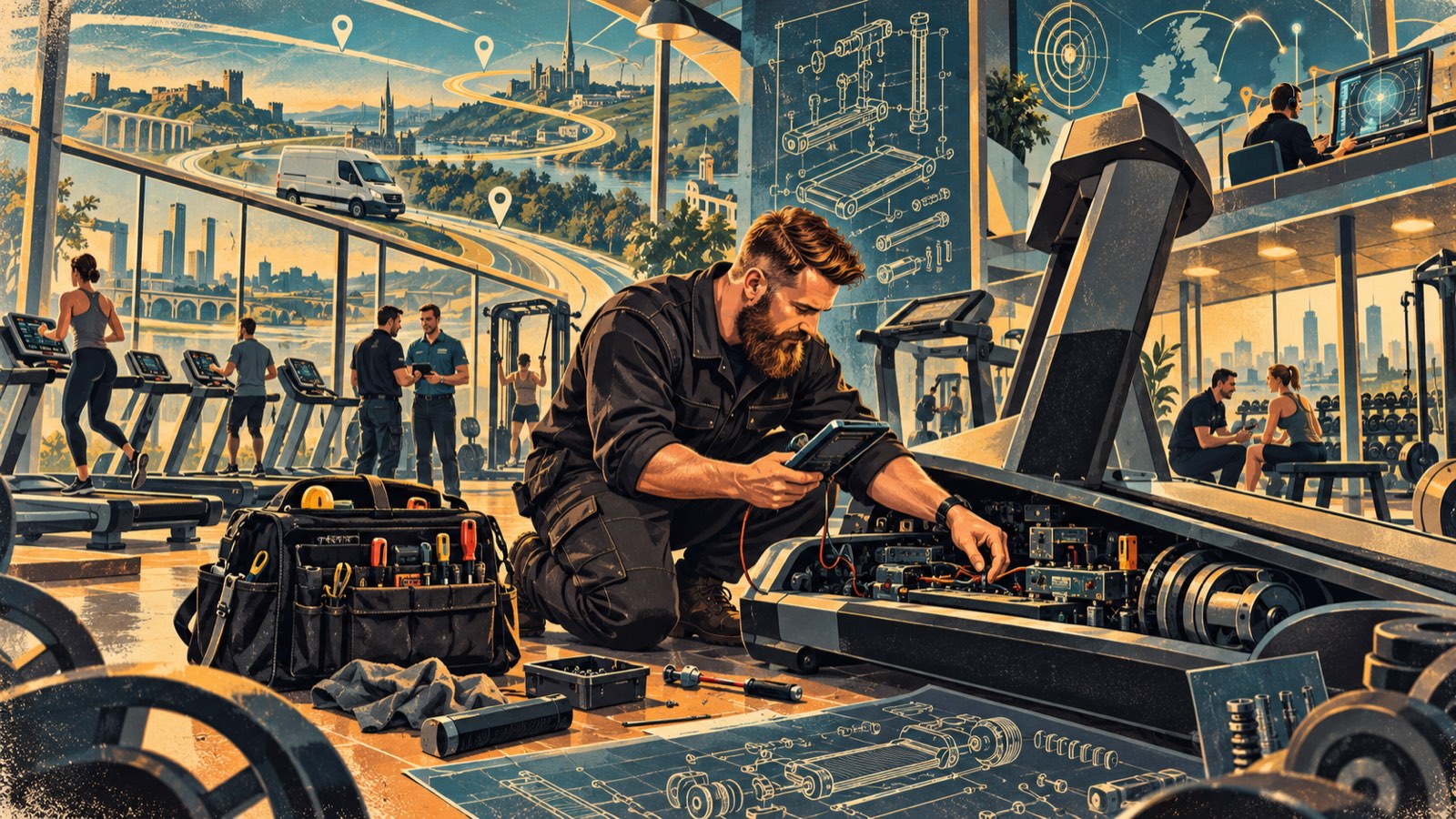
Twelve months with Precor x Peloton Commercial, a new industry, countless miles and a reminder that engineering is ultimately about people.
A year ago, I stepped into a completely new industry.
I had plenty of experience working in the field, dealing with customers, fault finding and solving problems, but commercial fitness equipment was a new world for me. New machines, new technology, new terminology and plenty to learn.
Twelve months later, I can safely say it was the right move.
My first year with Precor x Peloton Commercial has taken me across the country, into some incredible facilities and presented me with more technical challenges than I could possibly remember.
But when I look back at the year, the machines aren't actually what stand out most.
It's the people.
From a New Starter to a Field Service Technician
Starting in an unfamiliar industry is an interesting experience.
You bring skills with you, but suddenly you're surrounded by equipment you've never worked on, components you've never seen and faults you've never encountered.
There's a temptation to think that being an engineer means you're supposed to have all the answers.
I've increasingly learned that good engineering is often the opposite.
It's being prepared to ask questions.
It's knowing how to investigate something you don't understand.
It's listening when somebody has experience you don't yet have.
And then, eventually, being able to pass that knowledge on to somebody else.
During that first year, every repair added another little piece to the puzzle. Treadmills, bikes, strength equipment, consoles, electronics, mechanical systems and everything hiding underneath the covers became progressively less mysterious.
Of course, every time you think you've seen everything, a machine develops a fault that appears to have been invented specifically to ruin that theory.
That's field service.
The Country Became My Workshop
One of the biggest changes has been the travelling.
Field service gives you a peculiar view of the country. Motorways become familiar landmarks, service stations become unofficial offices and the back of the van becomes part workshop, part parts department and part carefully organised game of Tetris.
Then you arrive at a site and the environment changes completely.
Every facility is different. Every customer operates differently. Even two supposedly identical machines can have completely different lives depending on where they've been installed and how they're used.
That's part of what makes the job interesting.
You're rarely just following instructions. You're observing, diagnosing and adapting.
Ultimately, though, there's a simple purpose behind all of it:
The People Behind Field Service
The engineer might be the person the customer sees standing beside the machine, but field service is never really a one-person operation.
Behind every engineer is a much bigger network.
Other technicians share knowledge and experiences. Technical support helps unravel the particularly strange faults. Parts teams make sure components get where they're needed. Coordinators keep jobs moving. Customers provide the information that helps us understand what's happening on site.
And sometimes somebody simply answers the phone when you're staring at something thinking:
Right… I've never seen that before.
I've been fortunate to work alongside people who genuinely want each other to succeed.
The patience, encouragement and willingness to share knowledge during my first year made entering a completely new industry considerably easier.
Those working relationships have also turned into friendships, something I value enormously.
Every Job Teaches You Something
One of the things I enjoy most about engineering is that you're never really finished learning.
A successful repair teaches you something.
A difficult diagnosis definitely teaches you something.
And occasionally getting something completely wrong teaches you rather a lot.
Over the year I've become increasingly interested not only in how we repair equipment, but in everything surrounding that repair.
- How information reaches an engineer.
- How service history can help diagnose the next problem.
- How parts are identified.
- How technology can remove unnecessary friction.
- How customers are kept informed.
- How engineers can have better information available when they arrive on site.
I've realised that I don't particularly enjoy accepting "that's just how we do it" as the final answer.
I like questioning things.
Not because something is necessarily wrong, but because there might be another way to do it.
That curiosity has become a much bigger part of how I approach field service.
Engineering Is a People Business
Perhaps the biggest lesson from my first year isn't technical at all.
Engineering is about people.
We repair machines, but the reason those machines matter is because somebody wants to use them.
A customer needs their facility operational. A gym member wants to continue their training. A colleague needs information. An engineer needs support.
Technical ability matters enormously, but so do communication, patience, curiosity and being willing to help somebody.
Some of the most memorable moments from my first year weren't particularly spectacular repairs. They were conversations with customers, advice from another engineer, somebody taking five minutes to explain something or simply having a laugh after a long day.
Those moments add up.
Into Year Two
So, what comes next?
More miles, certainly.
More machines.
More faults that initially make absolutely no sense.
More learning.
More questions.
And, hopefully, fewer treadmills behaving as though they've developed personalities of their own.
But I also want Year Two to be about looking beyond the individual repair.
I want to keep developing technically, keep learning from the people around me and keep exploring ways technology, information and better systems can make life easier for engineers and provide an even better experience for customers.
Because after my first twelve months, one thing has become very clear:
One year down.
Plenty more road ahead. 🔧
And I'm excited to see where it leads.
RELATED PROJECT
- Field Service AppPROJECT_004 · PROTOTYPE