Nick Offerman: Making Things, Doing Things Properly, and the Value of Knowing How
I found Nick Offerman through what he does. I keep following him because of how he thinks, and because he shows you don't have to be just one thing.
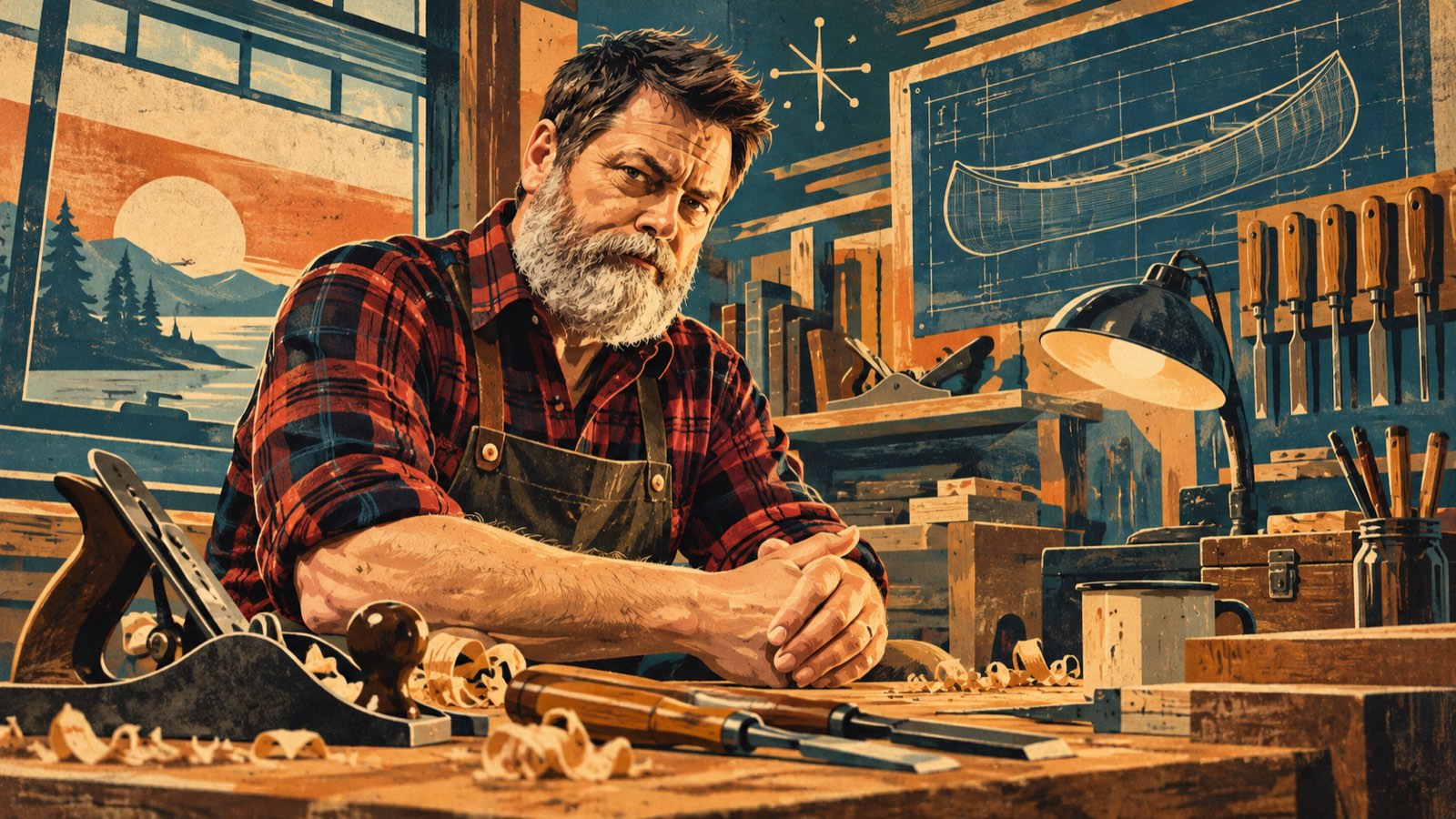
There are certain people you discover because of what they do, but you continue following them because of how they think.
Nick Offerman is one of those people for me.
Like a lot of people, my introduction to him was Ron Swanson in Parks and Recreation. The moustache. The deadpan delivery. The love of breakfast food. The almost religious appreciation for a well-made piece of furniture.
But the more I learned about Nick Offerman, the more I realised that the part I found interesting wasn't really Ron Swanson at all.
It was the bloke behind him.
An actor who is also a woodworker. A writer. A maker. Someone who can perform in front of a camera and then disappear into a workshop and make a canoe.
And, most importantly, someone who seems completely comfortable with the idea that you don't have to be just one thing.
The Man Behind the Moustache
Offerman's woodworking isn't a celebrity hobby invented after he became famous.
Long before Parks and Recreation, he worked building scenery for theatres in Chicago, then moved into carpentry, decks, cabins and eventually fine furniture. He established the Offerman Woodshop in Los Angeles in 2001.
That distinction matters to me.
The woodworking isn't part of the Nick Offerman brand.
It's part of Nick Offerman.
Even when acting became successful enough to consume more of his time, he continued making things. In fact, his real woodworking ability eventually became woven into Ron Swanson himself. Offerman has explained that the Parks and Recreation writers deliberately borrowed elements of his genuine woodworking life for the character.
There's something about that I really admire.
Your skills don't necessarily have to sit in neat little boxes.
One interest can feed another.
I Don't Want to Be One Thing Either
That's probably one of the biggest reasons Offerman resonates with me.
If someone asks what I do, the straightforward answer is that I'm a field service engineer.
But that doesn't really explain it.
I repair things.
I diagnose things.
I build websites.
I mess around with networking.
I design systems.
I coach netball.
I play ice hockey.
I take photographs.
I obsess over tools.
I'll notice something inefficient and immediately start wondering whether there is a better way of doing it.
And sometimes I'll build something simply because I want to know whether I can.
For years I think I subconsciously treated those things as separate interests.
Nick Offerman is one of several people who helped me realise that they don't necessarily need separating.
They're all branches of the same tree.
I like making things and solving problems.
Sometimes the material is wood.
Sometimes it's a broken machine.
Sometimes it's code.
Sometimes it's a website.
Sometimes it's an idea scribbled down because I've just thought, surely there's a better way of doing this?
The Workshop Mentality
One of Offerman's ideas that really sticks with me is his description of woodworking as essentially a sequence of problems.
You have some material, some tools, your hands and an idea of what you'd like the finished object to become.
Then you have to figure out everything in between.
That is basically field engineering.
You arrive at a machine that isn't working.
You have tools.
You have test equipment.
You have documentation.
You have experience.
And you have whatever clues the machine decides to give you that morning.
From there, you're solving a puzzle.
What happened?
Why did it happen?
What evidence do I have?
What do I test next?
And eventually:
How do I put this right?
That same mentality exists in nearly every project I enjoy.
Building a website isn't really about writing code.
Woodworking isn't really about cutting wood.
Repairing machinery isn't really about replacing parts.
They're all exercises in taking something that doesn't exist, doesn't work, or doesn't work well enough and figuring out the steps required to change that.
Make Mistakes
There's another part of Offerman's philosophy that I particularly like.
Mistakes are part of the process.
Talking about woodworking, he's been very open about the fact that becoming capable involved ruining wood, getting things wrong and learning from it.
That's incredibly important.
Because expertise can look almost magical when you only see the finished result.
You see the beautiful table.
You don't see the badly cut joint from five years earlier.
You see the finished website.
You don't see the version that completely broke at 11:47pm.
You see the engineer diagnose a fault quickly.
You don't see the years of staring at machines thinking:
"Well… that's new."
That's something I've increasingly learned to enjoy.
I don't particularly mind not knowing something.
Not knowing something just gives me something to investigate.
Tools Should Be Used
It's probably unsurprising that I also connect with Offerman's relationship with tools.
I love good tools.
Not because I want a pristine collection sitting untouched in a drawer, but because I appreciate objects designed to do their job properly.
A screwdriver with a handle that feels right after hours of use.
Hex keys that are easy to identify when you're kneeling beside a machine.
A tool bag that has slowly evolved around the way you actually work.
Safety glasses comfortable enough that you forget you're wearing them.
There is something satisfying about equipment that has clearly been designed by somebody who understands the job.
Offerman's appreciation of craftsmanship taps directly into that.
He has spoken about valuing objects that are well made and intended to last, rather than treating everything as disposable.
I understand that completely.
A scratched tool isn't ruined.
It's probably just finally becoming your tool.
Hands and Brain
Perhaps the biggest connection, though, is the relationship between thinking and doing.
Offerman has talked about making things with your hands as a way of exercising problem-solving ability, arguing that physically making something forces you to solve puzzles and adapt along the way.
That's exactly what I enjoy.
I'm fascinated by technology.
I love networking, software and the possibilities of AI.
But I don't want technology to replace curiosity.
I want it to amplify it.
Give me the documentation.
Give me the diagnostic software.
Give me AI.
Give me a multimeter.
Give me a screwdriver.
Then let me figure out what is actually happening.
Paddle Your Own Canoe
There's also something wonderfully appropriate about the title of Offerman's first book, Paddle Your Own Canoe.
The book mixes stories from his childhood, theatre career, carpentry, woodworking and life with his own thoughts about how to live.
And that title increasingly feels relevant to how I approach my own career.
My CV doesn't make perfect linear sense.
I've worked in retail.
Account management.
Television repair.
Children's residential support.
Field engineering.
Photography.
I've coached sport.
I've built websites.
I've started learning networking.
I've created projects simply because an idea wouldn't leave me alone.
On paper, it can look slightly chaotic.
From where I'm standing, though, there's a thread running through almost all of it.
Make Something
Offerman once described making things as something positive and healthy, particularly in a world where it's incredibly easy to become a passive consumer.
I think that's ultimately the part of his influence that matters most to me.
Make something.
It doesn't need to become a business.
It doesn't need thousands of followers.
It doesn't need to revolutionise an industry.
It doesn't even necessarily need to be particularly good the first time.
Build the shelf.
Repair the machine.
Write the article.
Make the website.
Learn the command.
Take the photograph.
Try the idea.
And when it doesn't quite work, work out why.
Then make version two.
That's the connection I see between people such as Nick Offerman and Adam Savage, and probably why I've gravitated towards both of them.
They make curiosity feel worthwhile.
They celebrate knowing how things work.
They treat tools as extensions of thought.
And they remind me that there's nothing wrong with having far too many interests.
You don't necessarily have to choose between being an engineer, a maker, a designer, a coach, a photographer or the bloke who disappears down a rabbit hole because he suddenly wants to understand how networks work.
Sometimes the interesting bit is what happens when all of those things collide.
Preferably on a workbench.
With a decent set of tools nearby.