Wera Kraftform Screwdrivers
Kraftform Plus Lasertip, VDE and Chiseldrivers. Some of the least glamorous tools in my bag, and some of the most used.
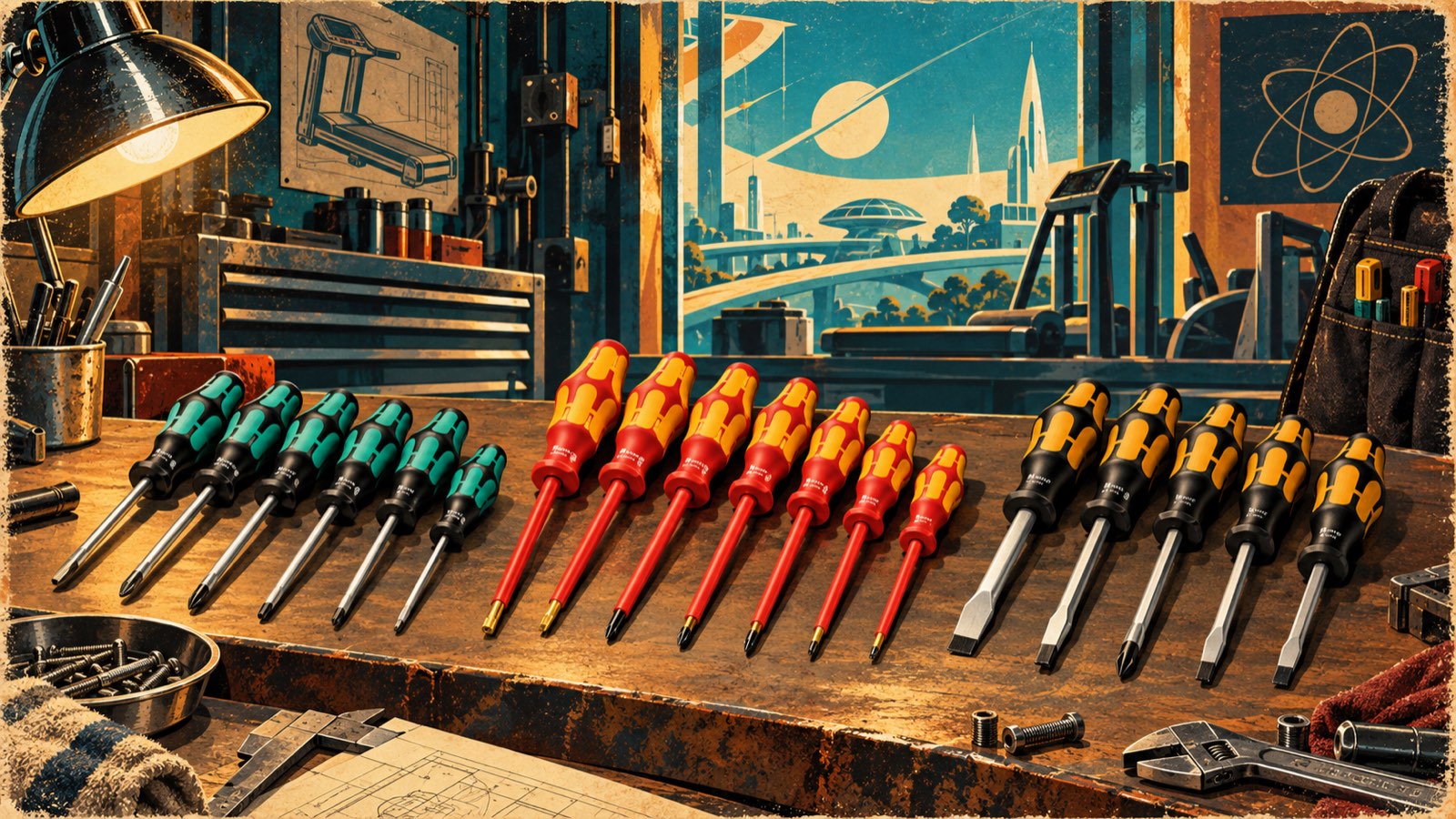
There are some tools in my bag that come out occasionally for a particular job, and there are others that barely seem to get a chance to cool down.
My Wera screwdrivers definitely belong in the second category.
Between the standard Kraftform Plus Lasertip drivers, the insulated VDE set and the considerably more substantial Chiseldrivers, I've ended up with a range that covers pretty much everything I regularly ask of a screwdriver.
And while a screwdriver might seem like one of the simplest tools in the bag, Wera has somehow managed to find an impressive number of little details to improve.
It Starts With the Handle
The first thing I noticed when I started using Wera screwdrivers was the Kraftform handle.
It looks unusual compared with a traditional screwdriver handle, but once you actually start using one, the shape makes a lot of sense.
Wera developed the Kraftform concept around the shape of the human hand, using different materials across the handle for different jobs. The harder sections allow the handle to move quickly through your hand when spinning a fastener, while the softer high-friction sections give you something substantial to grip when you need to apply more torque.
In day-to-day field service work, that difference matters.
I'm constantly moving between equipment, removing panels, accessing components, carrying out adjustments and then putting everything back together again. A screwdriver isn't something I'm necessarily holding for thirty seconds. On some jobs it might be in my hand repeatedly for a significant chunk of the visit.
That's where ergonomics stop being marketing fluff and start becoming genuinely useful.
The Kraftform handles are simply comfortable.
They give me plenty of control without feeling unnecessarily bulky, and when I need a bit more torque, the softer sections of the handle give me somewhere to properly plant my hand.
It's one of those designs that you stop consciously noticing after a while, which is probably one of the biggest compliments I can give it.
The tool just feels right.
Lasertip: A Tiny Detail That Makes a Big Difference
Then there are the tips.
Wera's Lasertip technology uses a precisely focused laser to create a sharp-edged microscopic surface structure on the tip. The idea is that the screwdriver effectively bites into the screw head rather than simply sitting against it. Wera says this reduces the amount of contact pressure required while improving force transfer.
In actual use, it's brilliant.
You notice it particularly when you're dealing with a fastener where access isn't ideal, or you're trying to keep a screwdriver properly seated while working at an awkward angle.
There's simply more grip.
Less slipping means less frustration, but it also means less chance of chewing up a perfectly good screw head because the driver has cammed out.
It's such a small engineering detail, but it's exactly the sort of thing I appreciate in a tool.
Rather than reinventing the screwdriver, Wera has looked at the annoying little problems that happen while using one and tried to engineer them out.
Even the hexagonal anti-roll section of the Kraftform handle falls into that category. Put the screwdriver down on a machine or workbench and it doesn't immediately make a bid for freedom and disappear underneath something.
Small detail.
Very welcome.
When Things Need a Little More Persuasion
Of course, sometimes being polite doesn't work.
That's where the Wera Chiseldrivers come in.
These are the bruisers of the collection.
They're designed specifically for situations where a normal screwdriver really shouldn't be subjected to what you're about to do to it.
Wera uses a continuous hexagonal pound-thru blade running through the handle, combined with an integrated impact cap. That means the tool is actually designed to accept hammer blows when you're loosening stubborn fasteners or using the driver for light chiselling work.
And I love them.
There are plenty of situations in engineering where the official instruction might essentially translate to:
"This should come apart."
It doesn't.
Something has seized, corroded, become stuck or simply decided that it has lived there long enough to claim squatters' rights.
That's when having a screwdriver you can confidently give a knock with a hammer becomes incredibly useful.
Instead of abusing one of my normal drivers, I can reach for something actually designed to take the punishment.
They're reassuringly substantial without sacrificing the excellent Kraftform handle that makes the normal drivers so comfortable.
And Then There Are the VDE Drivers
At the other end of the spectrum are my Wera VDE screwdrivers.
They retain that familiar Kraftform feel but add individually tested insulation for electrical work.
Wera tests its VDE screwdrivers at 10,000 V to ensure safe working at the permitted 1,000 V, with the drivers manufactured and tested in accordance with IEC 60900.
That's exactly what I want from safety equipment.
There's no reason for an insulated screwdriver to feel like a compromised version of your normal screwdriver. With these, I still get the handle I like, the grip and control I'm used to and, on applicable drivers, that excellent Lasertip engagement.
They just happen to have another layer of engineering behind them.
But when an insulated driver is the appropriate tool for the job, I want one I trust.
These are mine.
One Family of Tools
I think that's ultimately what I like most about the Wera screwdriver range.
There's consistency.
My everyday Kraftform Plus drivers feel familiar.
My VDE drivers feel familiar.
My Chiseldrivers feel familiar.
The application changes, but the basic philosophy behind the tool doesn't.
The handles are designed around the hand. The materials change across different areas of the grip depending on what that part needs to do. The tips are engineered to engage properly with the fastener. The handles don't roll away when you put them down.
And where the job demands something different, Wera changes the tool rather than simply expecting the standard screwdriver to cope.
That's good tool design.
My verdict
Screwdrivers are probably some of the least glamorous tools in my bag, but they're also among the most frequently used.
That's exactly why I think it's worth buying good ones.
The Wera Kraftform Plus range has become my go-to because it gets the fundamentals right and then adds clever little engineering details on top.
The Kraftform handle is genuinely comfortable during repeated use. The Lasertip drivers grip fasteners brilliantly. The VDE range gives me the same familiar feel when I need an appropriately insulated tool, and the Chiseldrivers are there for those occasions when diplomacy has officially failed.
They're not flashy tools for the sake of being flashy.
They're just extremely well thought out screwdrivers.
And mine get used every single day.
- Comfort ★★★★★
- Grip & control ★★★★★
- Build quality ★★★★★
- Range & versatility ★★★★★
- Everyday usefulness ★★★★★
- Overall ★★★★★
Would I buy them again? Without hesitation.