Every Tool's a Hammer: The Book That Gave My Curiosity Permission
Adam Savage's book isn't really about tools. It's about curiosity, and curiosity is the thread connecting almost everything I do.
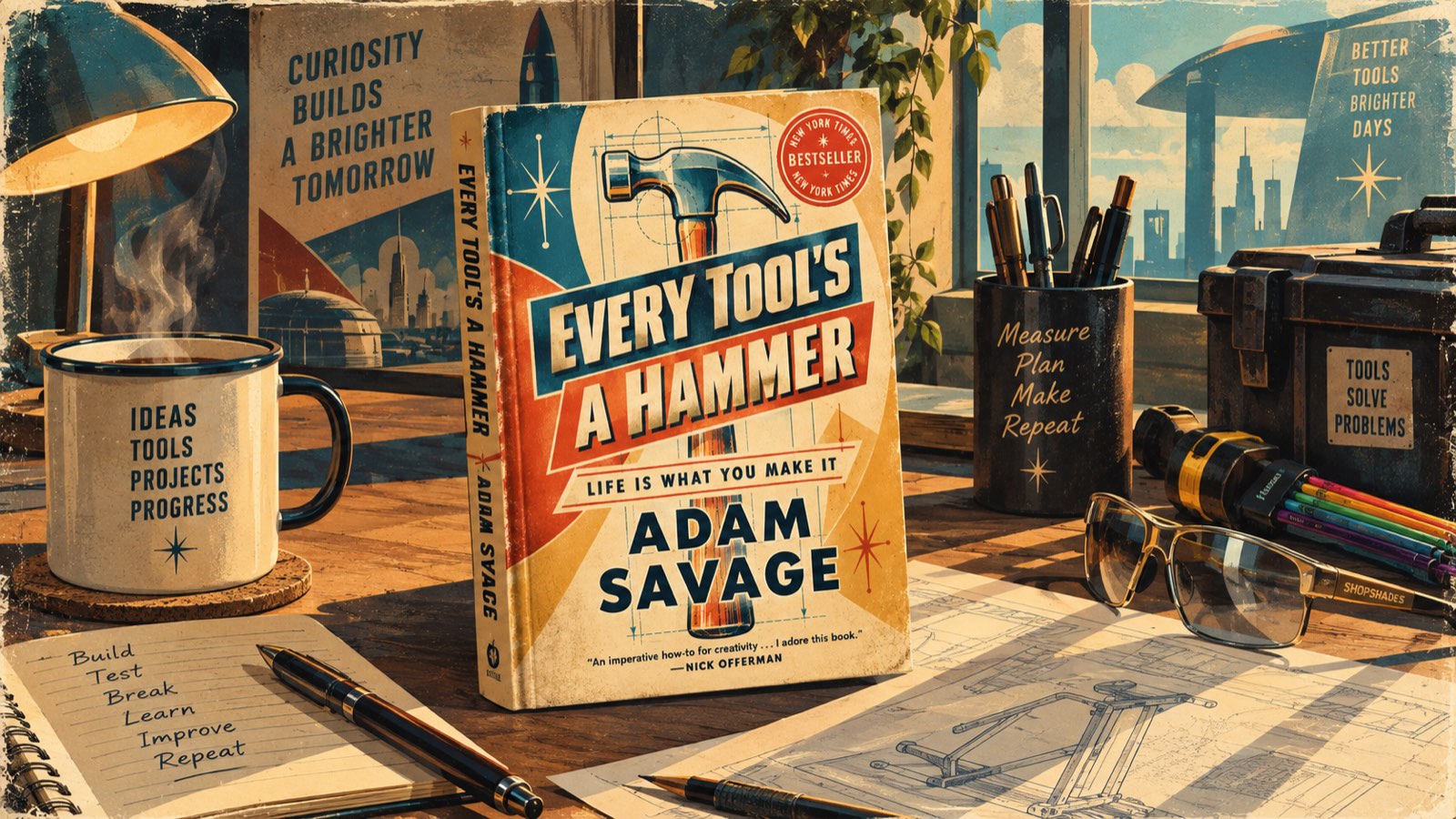
There are books you read, enjoy, put back on the shelf and gradually forget about.
Then there are books that manage to put words around something you have been doing for years without ever really knowing how to describe it.
For me, Every Tool's a Hammer: Life Is What You Make It by Adam Savage is firmly in the second category.
It isn't really a book about tools.
It isn't even necessarily a book about making things.
It is a book about curiosity.
And looking back at my hobbies, the projects I throw myself into and the way I approach my career, curiosity is probably the thread connecting almost everything I do.
Adam Savage
Adam Savage has been an influence on me for considerably longer than this book has existed.
Growing up, while plenty of people my age were watching Cartoon Network or Nickelodeon, I could happily disappear into the Discovery Channel.
How It's Made was fascinating.
But MythBusters was something else entirely.
Adam and Jamie weren't simply explaining whether something worked. They would build something, test it, break it, change it, test it again and occasionally blow it into several thousand pieces.
For someone fascinated by how things work, it was brilliant.
But the thing I connected with most was Adam's enthusiasm.
There was seemingly no embarrassment attached to being completely fascinated by something. If something was interesting, that was reason enough to explore it.
Years later, through Adam's work beyond MythBusters, particularly his making, workshops and projects, that philosophy became even clearer.
Being curious wasn't a distraction from doing useful work.
A Book About Making, Without Really Being About Making
Every Tool's a Hammer is described by its publisher as a chronicle of Adam's life as a maker, drawing on more than forty years of building, moulding, breaking, experimenting and learning. But Adam also describes the book as something much more interesting: a kind of permission slip to pursue the things that fascinate you and discover where they lead.
That idea really resonates with me.
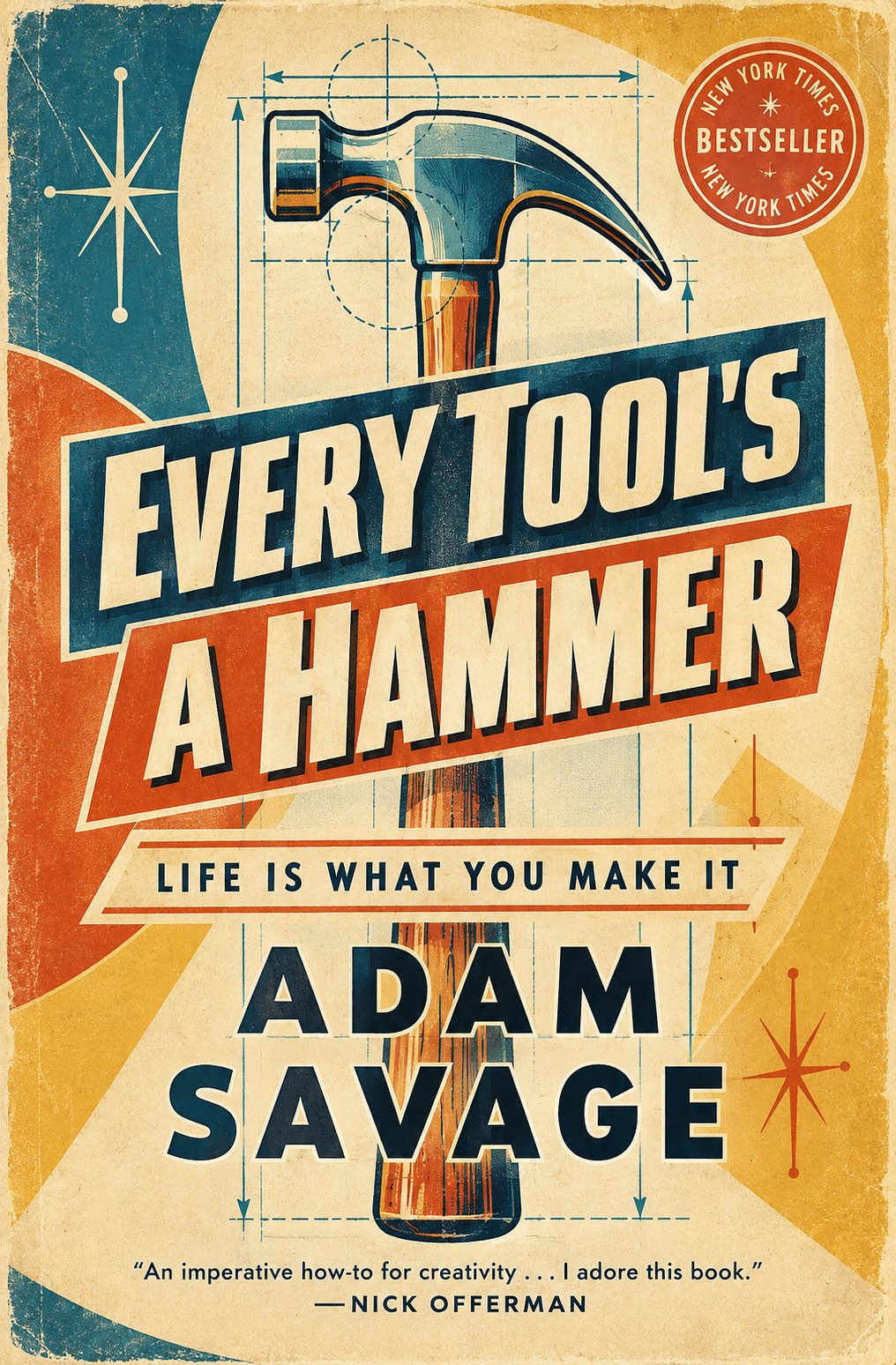
The book moves between practical lessons, stories from Adam's career, mistakes, tools, materials, organisation, problem-solving and the psychology behind actually turning an idea into something real.
And importantly, it doesn't pretend creativity is some beautifully organised process where inspiration strikes and a perfect object magically appears.
Making is messy.
Ideas change.
Things don't fit.
You buy the wrong thing.
You break something.
You discover the solution you were absolutely convinced would work doesn't.
And then you try something else.
Adam talks about creativity as something full of wrong turns and mistakes rather than a straight path towards the finished result.
That is probably one of the biggest ideas I've taken from him.
You Don't Need Permission to Be Interested in Something
One of my favourite ideas surrounding the book is incredibly simple:
If something fascinates you, explore it.
You don't necessarily need a commercial reason.
You don't need a qualification in it.
You don't need to already be good at it.
And you certainly don't need somebody else to tell you that you're allowed to be interested.
That's something I've increasingly embraced in my own life.
I can disappear down a rabbit hole about networking.
Or website design.
Or tools.
Or photography.
Or how a particular mechanical system works.
I can spend hours building something simply because I wondered whether I could.
One project frequently leads into another subject, which leads into another skill, which leads into another project.
From the outside, those interests can look completely disconnected.
Inside my head, they're all part of the same workshop.
The Workshop Isn't Always a Workshop
Perhaps the biggest influence Adam has had on me is changing what I consider making to be.
You don't have to be standing behind a bandsaw covered in sawdust to be a maker.
A website can be something you make.
A photograph can be something you make.
A system can be something you make.
A piece of software can be something you make.
A better process can be something you make.
Even an idea that improves how somebody approaches a problem can be something you've made.
That has become increasingly relevant as my interests have moved between physical and digital projects.
Sometimes I'm working with actual tools.
Other times I'm sitting behind a computer building something that didn't exist the day before.
The material has changed.
The process really hasn't.
From Creative Hobbies to Engineering
What's interesting is how much of this philosophy has followed me into my professional life.
Field engineering might seem quite distant from Adam Savage building film props in a workshop, but the underlying thought process is surprisingly familiar.
You arrive at something that isn't working.
You observe.
You gather information.
You form a theory.
You test it.
Sometimes you're right.
Sometimes the machine immediately informs you that your brilliant theory was complete nonsense.
So you gather more information and try again.
That's troubleshooting.
But it's also experimentation.
And that's where the influence becomes more important than simply making things in my spare time.
Adam helped reinforce the idea that not knowing something isn't a dead end. It's the beginning of the interesting bit.
I've become increasingly comfortable saying:
"I don't know. Let's find out."
That mentality has probably influenced my career more than any particular tool or technical skill.
Questioning Things
There's another part of Adam's influence that I recognise more and more as I get older.
I question things.
Not necessarily because I think something is wrong, but because I want to understand why it works that way.
Why do we do this?
Could this be easier?
What happens if we change this?
Could I build something that solves that?
Is there another way?
That mindset spills into almost everything.
It's why I enjoy troubleshooting.
It's why I enjoy technology.
It's why I enjoy building websites and experimenting with software.
It's why I enjoy finding better ways to organise information.
And it's why a small observation can occasionally become an enormous project after I've disappeared approximately twelve miles down a rabbit hole.
That tendency isn't always convenient.
But I've stopped viewing it as something I should suppress.
Tools Matter, But They're Not the Point
Given the title Every Tool's a Hammer, you'd be forgiven for expecting 300 pages about workshop equipment.
Tools certainly feature heavily. The publisher describes the book as a toolbox of problem-solving containing Adam's experiences with tools, techniques and materials.
But the deeper lesson I took from it is that owning tools isn't what makes somebody capable.
Understanding how to approach a problem does.
I love good tools. Anyone who has seen my tool bag will probably consider that a spectacular understatement.
But the best tool you have is still your ability to stop, look at a problem and think.
Sometimes the perfect tool exists.
Sometimes you have to improvise.
Sometimes you need to make the tool.
And occasionally the most important thing is recognising that you've been trying to solve the wrong problem in the first place.
Failure Is Part of the Build
Engineering teaches you fairly quickly that things don't always work.
So does making.
One of the things I've always enjoyed about Adam's approach is the lack of theatre around failure.
A failed attempt isn't wasted effort.
It produced information.
That distinction matters.
I've carried that into my own projects.
I've built things that went nowhere.
I've had ideas that sounded brilliant in my head and considerably less brilliant once they existed.
I've redesigned things.
Started again.
Changed direction.
Broken things while trying to fix them.
But every one of those experiences leaves something behind.
A technique.
A bit of knowledge.
A better question.
Or simply the confidence that the next time something goes wrong, I'll probably figure it out.
Life Is What You Make It
The subtitle of the book is Life Is What You Make It.
I think that's ultimately why the book means so much to me.
It's not really telling you how to build a particular object.
It's encouraging you to become someone who makes.
Someone who follows curiosity.
Someone who isn't afraid to be fascinated by something.
Someone willing to start before they know exactly where they're going.
Someone willing to fail, learn and try again.
Adam Savage didn't make me interested in tools, engineering, technology or creative projects.
Those interests were already there.
What he did, first through MythBusters, then through his work as a maker and finally through Every Tool's a Hammer, was demonstrate that those interests don't need to live in separate boxes.
The engineer.
The photographer.
The person building a website at midnight.
The person reorganising a toolbox.
The person disappearing down a networking rabbit hole.
The person wondering whether there might be a better way of doing something.
They're all the same person.
They're all making.
And perhaps that's the biggest lesson I've taken from Adam Savage: