Gumption: Curiosity, Craft and the People Who Actually Do Things
Nick Offerman assembles a room full of gutsy, curious, constructive troublemakers and invites you to pull up a chair. A book about people, not pedestals.
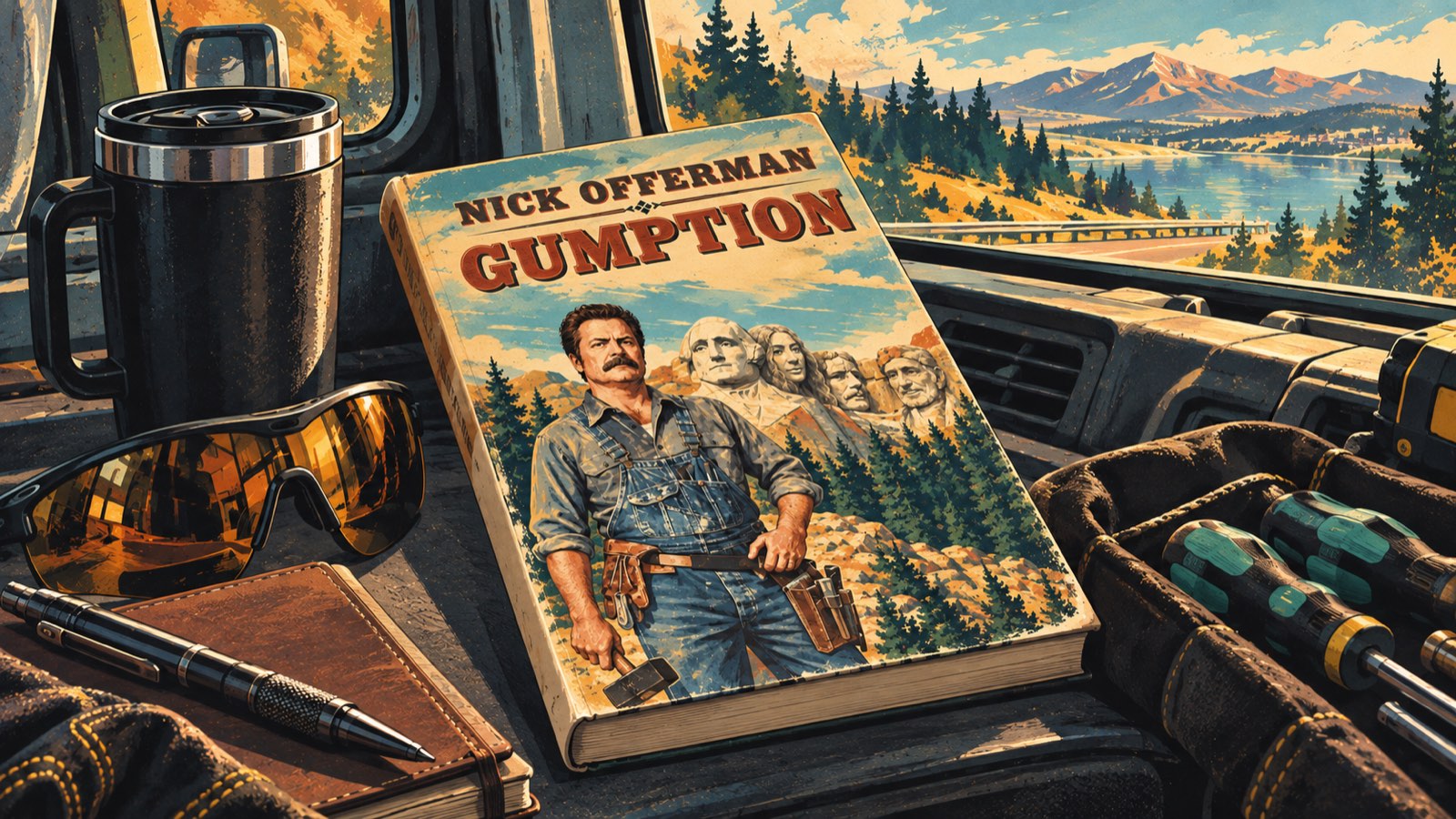
There are books you read for information. There are books you read for entertainment. And then there are books that feel more like spending a few evenings in good company.
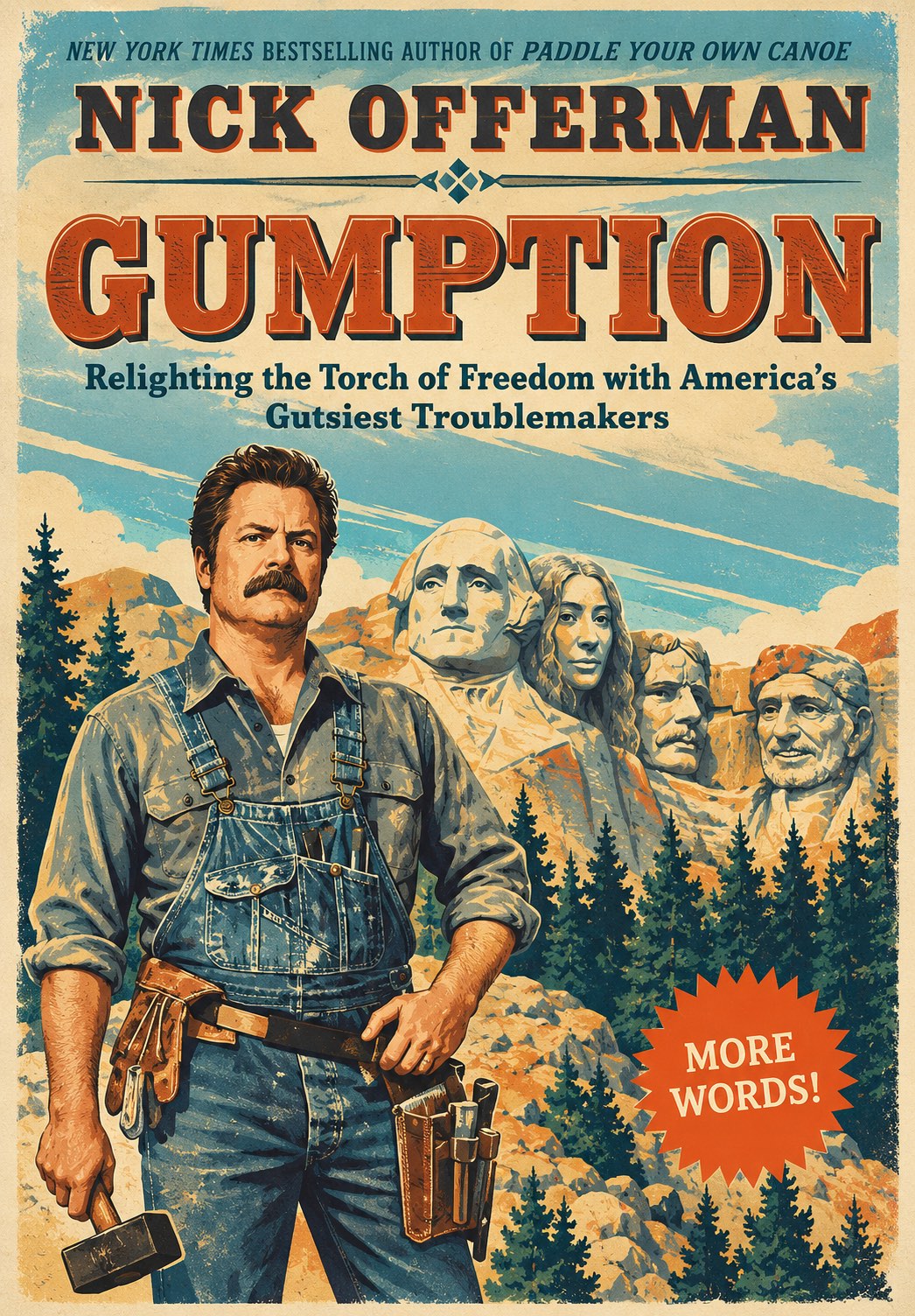
Gumption: Relighting the Torch of Freedom with America's Gutsiest Troublemakers by Nick Offerman falls firmly into that last category.
It is a beautifully curated collection of conversations, stories, observations and ideas built around people Offerman admires. But what makes it particularly enjoyable is that it never really feels like a conventional collection of biographies.
Instead, it feels like Nick has assembled a room full of fascinating people and invited you to pull up a chair.
What Exactly Is Gumption?
The word itself is wonderfully old-fashioned.
Gumption.
Initiative. Resourcefulness. Courage. Common sense. The willingness to get up, have a go and actually do something.
It is one of those words that somehow contains an entire philosophy.
And that philosophy runs throughout the book.
Offerman explores the lives and ideas of a remarkably varied collection of Americans, ranging from historical figures such as George Washington and Frederick Douglass to writers, musicians, craftspeople, comedians, farmers and modern cultural figures.
On paper, some of these people have very little in common.
That is exactly what makes the book interesting.
The connecting thread isn't profession, fame or even necessarily politics.
It is gumption.
These are people who questioned things. Built things. Challenged accepted wisdom. Developed skills. Stood behind their principles. Took risks. Failed. Learned. Tried again.
A Book About People, Not Pedestals
One of my favourite things about Gumption is that Offerman doesn't simply present a collection of heroes and tell us how wonderful they all are.
There is much more humanity to it than that.
The people in the book have contradictions, flaws and complicated histories. Offerman is willing to explore those things rather than sanding off the uncomfortable edges.
I think that makes their achievements considerably more interesting.
People aren't statues.
They're messy.
They make mistakes. They change their minds. They learn. Sometimes they don't learn quickly enough.
And occasionally history forces us to reconsider people we were taught to view in much simpler terms.
That willingness to look again, ask questions and accept complexity is one of the things I really enjoyed about the book.
Curiosity as a Way of Life
There is another theme running through Gumption that resonates enormously with me:
Curiosity.
Why is something done that way?
Who decided that?
Could it be better?
What happens if I try this?
How did somebody make that?
Those questions have followed me through almost everything I've enjoyed doing.
Engineering. Photography. Building websites. Fixing machines. Networking. Coaching. Tools. Design. Making things simply because I wanted to know whether I could.
I have never particularly liked accepting "that's just how it's done" as a complete answer.
And Gumption celebrates people with that same itch.
The people who poke the machinery of the world with a metaphorical screwdriver just to understand what makes it tick.
Sometimes they discover something brilliant.
Sometimes a spring shoots across the workshop.
Either way, they've learned something.
The Dignity of Knowing How to Do Something
Given that this is Nick Offerman, craftsmanship naturally occupies an important place in the book.
And I love that.
There is something deeply satisfying about becoming competent with your hands.
Knowing how to sharpen something.
Repair something.
Build something.
Cook something properly.
Grow something.
Understand the tool you're holding rather than simply owning it.
That idea has become increasingly important to me over the years.
I love good tools, but the interesting part isn't collecting them. It's understanding why a good tool is good.
Why does this screwdriver grip better?
Why has somebody shaped this handle this way?
Why does this mechanism work?
Why did the designer choose this material?
Good workmanship leaves fingerprints everywhere, even when the person who made something is nowhere to be seen.
Gumption understands that.
Skill matters.
Practice matters.
Taking pride in your work matters.
Doing Things Properly
There is a wonderfully unfashionable idea buried throughout much of Offerman's work: doing things properly is worthwhile even when nobody is watching.
That doesn't mean chasing perfection.
It means caring.
If you're repairing something, repair it properly.
If you're building something, think about the person who will eventually use it.
If you're learning a skill, put the hours in.
If you don't know something, admit it and learn.
If you make a mistake, own it and improve.
That's a philosophy I recognise immediately.
Working in field service has reinforced it enormously. There is a difference between making a machine work again and understanding why it failed.
There's a difference between completing a job and leaving something knowing you've done the best work you reasonably could.
That difference is craftsmanship.
The Beautiful Variety of It
Perhaps the thing I enjoy most about Gumption is its range.
It happily wanders between history, politics, woodworking, agriculture, music, comedy, environmentalism, civil rights, creativity and culture.
That shouldn't work.
Yet somehow it does.
Because the real subject isn't any one of those things.
It's people who care deeply about something.
I find those people endlessly fascinating.
Give me somebody who can enthusiastically explain a ridiculously specific subject for an hour and I'm probably going to listen.
Tell me about the obscure woodworking joint.
Explain the network architecture.
Show me why that engine was revolutionary.
Tell me why this particular hammer has been manufactured the same way for decades.
Explain why that tiny design decision matters.
Passion is infectious when it's genuine.
And Gumption is packed with it.
Constructive Troublemaking
I also love Offerman's use of the idea of the troublemaker.
Not someone causing chaos simply for the enjoyment of it.
Someone willing to challenge the default.
That's an important distinction.
Many of the things we now consider obvious only became obvious because somebody was once annoying enough to ask:
Why?
Why can't this be different?
Why shouldn't people have that right?
Why are we wasting this?
Why are we making it this way?
Why hasn't somebody fixed this?
That final question might be one of the most dangerous sentences in my vocabulary.
Because it is very often followed by:
"I wonder if I could build something…"
And suddenly I've accidentally started another project. The idea drawer is the evidence.
A Book That Encourages Participation
What I took from Gumption wasn't a list of people I should attempt to imitate.
It was something much more useful.
Participate.
Make things.
Learn things.
Question things.
Help people.
Develop skills.
Read about people outside your normal interests.
Talk to people who know things you don't.
Be prepared to change your mind when you learn something new.
And occasionally be enough of a pain in the backside to challenge something that doesn't make sense.
You don't need to change the world.
Sometimes gumption is considerably smaller than that.
It might be repairing something rather than throwing it away.
Learning a skill you've always wanted to understand.
Helping somebody with something you happen to know how to do.
Starting a project without knowing exactly how you'll finish it.
Or simply looking at something and thinking:
"I reckon I could make that better."
Why It Earned a Place on My Shelf
Gumption is difficult to squeeze neatly into one category.
It is part history book, part interview collection, part cultural commentary, part philosophy and part Nick Offerman wandering through the things he finds interesting.
Which, frankly, is probably why I enjoyed it so much.
My own interests have never fitted particularly neatly into boxes either.
Engineering sits next to photography.
Photography sits next to web development.
Web development wanders into design.
Design leads into woodworking.
Woodworking inevitably leads to tools.
Tools somehow lead back to engineering.
There is no carefully drawn map.
Just curiosity connecting one thing to another.
And perhaps that's what I like most about Gumption.
It doesn't present curiosity as something you eventually grow out of once you've found your profession.
It treats curiosity as something worth protecting.
Keep learning.
Keep making.
Keep asking questions.
Keep meeting people who know things you don't.
Keep developing useful skills.
Keep caring about the quality of what you put into the world.
And every now and again, when something doesn't quite make sense, have enough gumption to cause a little constructive trouble.
I can get behind that.
PART OF THIS STORY
- The Greatest Love Story Ever Told: Finding Your Person Without Losing YourselfThoughts · 19.09.26
- Where the Deer and the Antelope Play: Curiosity Doesn't Stop at the Workshop DoorThoughts · 19.09.26
- Paddle Your Own Canoe: Building a Life That Is Actually YoursThoughts · 19.09.26
- Carroll Shelby: Cobras, Mustangs, GT40s and a Life Built Around Making Things BetterThoughts · 18.09.26
- Nick Offerman: Making Things, Doing Things Properly, and the Value of Knowing HowThoughts · 16.09.26
- Every Tool's a Hammer: The Book That Gave My Curiosity PermissionThoughts · 15.09.26