Carroll Shelby: Cobras, Mustangs, GT40s and a Life Built Around Making Things Better
Racing driver, constructor, engineer, problem solver. Three completely different cars, one philosophy: take something good, understand what is holding it back, and make it better.
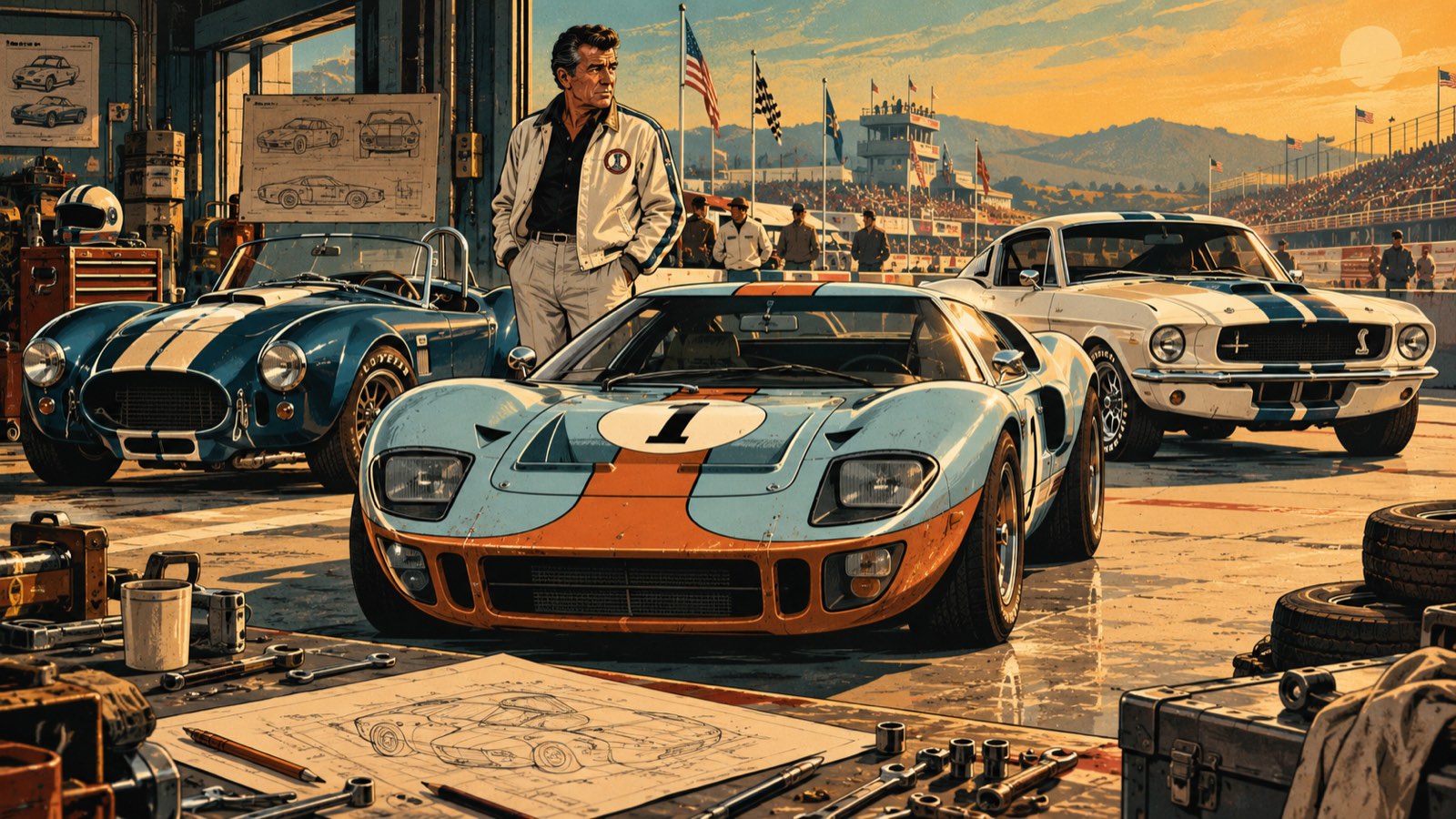
Some people inspire you because of one thing they created.
Carroll Shelby is different.
For me, it's difficult to look at his life without finding something fascinating around every corner. Racing driver. Le Mans winner. Constructor. Engineer. Entrepreneur. Problem solver.
And then there are the cars.
The Cobra.
The Shelby Mustang.
The Ford GT40.
Three completely different machines, each carrying that unmistakable Shelby philosophy: take something good, understand what is holding it back, and make it better.
Of the three, the Ford GT40 remains my all-time favourite car.
But together, they represent something that's influenced far more than my taste in cars.
They represent a way of thinking.
Racer First
Before the cars carrying his name, Carroll Shelby was the bloke sitting behind the wheel.
He raced throughout the 1950s in machinery from manufacturers including Ferrari, Maserati and Aston Martin, eventually reaching the top of endurance racing in 1959 when he and Roy Salvadori won the 24 Hours of Le Mans for Aston Martin.
Then his career took an unexpected turn.
A heart condition forced Shelby to retire from professional racing in 1960.
That could have been the end of the story.
Instead, Shelby effectively moved from one side of the toolbox to the other.
He couldn't continue racing professionally, so he took everything he'd learned as a driver and began building cars instead.
I think that's one of the things about Shelby's life that resonates with me most.
The Cobra: Take a Small British Sports Car, Add a Bloody Great V8
The Shelby Cobra might be one of my favourite examples of automotive problem solving, because the basic idea sounds almost comically straightforward.
Shelby saw potential in the lightweight British AC Ace.
Ford had a new lightweight small-block V8.
Shelby's answer was essentially:
Why aren't these two things together?
That question produced something extraordinary.
The AC Ace chassis was adapted to accept Ford V8 power, creating the car we now know as the Shelby Cobra.
And it evolved rapidly.
Eventually the legendary 427 Cobra arrived, with its enormous Ford big-block V8 stuffed into a tiny roadster.
It shouldn't look as right as it does.
Long bonnet.
Huge arches.
Side pipes.
Tiny windscreen.
Massive tyres.
Almost no unnecessary decoration.
Everything about it communicates what the car exists to do.
Go very, very quickly.
Why I Love the Cobra
The Cobra represents one of my favourite forms of creativity.
Combining things.
You don't always need to invent something entirely from scratch. Sometimes innovation comes from looking at two existing ideas and realising they belong together.
I find myself doing that constantly.
Whether I'm working with tools, repairing equipment, building websites or disappearing into another project, I'm forever taking bits of different systems and thinking:
"What happens if I connect this to that?"
Sometimes nothing.
Sometimes several hours of troubleshooting.
Occasionally something brilliant.
That's part of the fun.
The Cobra feels like that philosophy made from aluminium, steel, petrol and questionable amounts of horsepower.
The Shelby Mustang
Then Shelby turned his attention to something completely different.
The Ford Mustang.
When the Mustang appeared in 1964, it was already destined to become an icon. But Ford wanted a Mustang with genuine competition credentials.
So the Mustang went to Shelby American.
And Shelby did what Shelby did.
He made it faster.
Sharper.
Louder.
More purposeful.
The 1965 Shelby GT350 transformed the Mustang into a serious performance machine. The early GT350s stripped away some of the ordinary road-car softness and concentrated on what mattered: performance.
The GT350R pushed that idea even further into competition.
And that's another part of Shelby's work that I love.
He didn't simply bolt horsepower onto things.
There was an understanding that the entire package mattered.
Power.
Weight.
Suspension.
Brakes.
Cooling.
Tyres.
Reliability.
The whole machine had to work together.
The Mustang I've Always Loved
There's something about the Shelby Mustang that sits perfectly between muscle car and racing machine.
Especially those early GT350s.
The stripes.
The bonnet scoop.
The stance.
The wonderful simplicity of the interior.
And, naturally, a Ford V8 providing the soundtrack.
Later Shelby Mustangs became increasingly aggressive, particularly the GT500, but the philosophy remained recognisable.
Take the Mustang.
Find its potential.
Turn everything up.
There's something beautifully uncomplicated about that.
Then Came the GT40
If the Cobra represents Shelby's ability to combine ideas, and the Mustang represents his ability to develop an existing platform, the GT40 represents something else entirely.
Persistence.
And this is the car that sits above everything else for me.
My all-time favourite.
The Ford GT40 story has become automotive legend, although the real history is much more interesting than the simplified Ford versus Ferrari version.
After Ford's attempt to purchase Ferrari collapsed in 1963, Ford committed itself to developing a racing programme capable of challenging Ferrari at the world's greatest endurance races, particularly Le Mans.
The GT40 was not solely a Shelby creation.
Far from it.
It was the product of an extraordinary collection of engineering talent on both sides of the Atlantic. People including Roy Lunn, Eric Broadley, John Wyer and Bruce McLaren were involved during the GT40's early development.
The car had speed.
What it didn't initially have was reliability.
Failure Was Part of the Engineering
Ford arrived at Le Mans in 1964 with three GT40s.
None finished.
That's the bit of the story I actually love.
Because the GT40 wasn't some miraculous machine that appeared fully formed and immediately destroyed the competition.
It failed.
Things broke.
Aerodynamics caused problems.
Gearboxes caused problems.
Brakes caused problems.
Reliability caused problems.
So they went back to work.
Eventually, Carroll Shelby and Shelby American became a major part of turning that promising racing car into a race winner.
And alongside Shelby was another person whose name belongs permanently in this story.
Ken Miles.
Miles wasn't simply somebody who drove the finished product. He was instrumental in developing it. He could feel what the car was doing, communicate it to the engineering team and help turn those observations into improvements.
That relationship between technician, engineer and driver fascinates me.
Diagnose.
Change.
Test.
Repeat.
That's field service with considerably more petrol.
The GT40 Mk II
Eventually the GT40 evolved into the brutal Mk II.
Behind the driver sat Ford's enormous 427 cubic-inch V8.
But putting a gigantic engine into the car created another series of problems.
More power meant more heat.
More speed meant more braking.
More weight meant more stress.
So the engineering continued.
Ford developed dynamometer testing that recreated the Le Mans duty cycle. Engines were subjected to extraordinary endurance testing. Braking systems were developed so components could be changed quickly during a race.
Cooling improved.
Aerodynamics improved.
Gearboxes improved.
Reliability improved.
Hundreds of little problems were gradually engineered out of the car.
And that's the part I find inspiring.
Le Mans, 1966
Then everything came together.
Three Ford GT40 Mk IIs crossed the finish line at the 1966 24 Hours of Le Mans.
First. Second. Third.
Bruce McLaren and Chris Amon were officially classified as the winners.
Ford had finally achieved what the programme had been created to accomplish.
And it wasn't finished.
GT40 variants returned to win Le Mans again in 1967, 1968 and 1969.
Four consecutive victories.
For Carroll Shelby there was a wonderful symmetry to the whole thing.
In 1959, he'd won Le Mans sitting behind the wheel.
In 1966, he helped win it from the other side of the pit wall.
Cobra. Mustang. GT40.
When I look at those three cars together, I think they tell the Shelby story better than any biography could.
The Cobra. Take two things that shouldn't necessarily belong together and discover that they absolutely do. Creativity.
The Shelby Mustang. Take something already good, understand its potential and improve the entire package. Development.
The GT40. Build something ambitious. Fail. Diagnose why. Improve it. Try again. Persistence.
And those three ideas have become increasingly important to me.
Why Shelby Inspires Me
The older I've got, the more I've realised that I'm happiest when I'm making, repairing or improving something.
I don't particularly enjoy accepting that something works simply because it works.
I want to know why.
Why is that component there?
Why did they design it that way?
Why has it failed?
Could it be repaired?
Could it be improved?
Could I build something that does it differently?
That curiosity has followed me throughout my career and into almost every hobby I've accumulated along the way.
It's there when I'm repairing equipment.
It's there when I'm looking through my tools.
It's there when I'm learning networking.
It's definitely there when I start building a website and somehow turn a relatively straightforward idea into an entire platform because I've thought:
"Hang on… wouldn't it be cool if it could also do this?"
That mentality feels very Shelby to me.
Build Something
There's another reason I find Carroll Shelby's story inspiring.
His career changed dramatically when his health meant he could no longer race professionally.
He could have walked away from motorsport.
Instead, he redirected everything he knew into something else.
And what followed wasn't some small second chapter.
It produced the Cobra.
The GT350.
The GT500.
And helped transform the GT40 into a Le Mans winner.
There's an important lesson in that.
The route you're travelling can change without the destination disappearing.
Skills transfer.
Experience accumulates.
Curiosity survives career changes.
Sometimes something you learned ten years ago suddenly becomes useful in something you're doing today.
I've experienced that throughout my own career.
Engineering, customer service, photography, coaching, technology, web development, troubleshooting and making things might look like completely different boxes on paper.
To me they're increasingly becoming parts of the same toolbox.
My Three Shelby Icons
If I somehow found myself standing in front of three garage doors and could keep whatever was behind them, I'd have a serious problem.
Behind door one: a Shelby Cobra 427. Tiny British roadster. Enormous American V8. Side pipes. Absolutely ridiculous.
Behind door two: a Shelby GT350. One of the most recognisable shapes ever made, transformed into a proper performance machine.
And behind door three: a Ford GT40.
I'm opening door three.
Every single time.
Because as much as I love the Cobra and Mustang, the GT40 is something else.
Forty inches tall.
Engine behind your head.
Barely enough room inside.
Built for one of the toughest races on Earth.
And absolutely beautiful.
The Question That Stuck
Ultimately, I think the biggest influence Carroll Shelby has had on me can be reduced to a question.
It's a question behind the Cobra.
It's behind the Mustang.
It's behind the GT40.
And it's increasingly behind the things I build myself.
How can I make this better?
Not necessarily bigger.
Not necessarily more complicated.
Better.
Sometimes that means changing one tiny component.
Sometimes it means taking two existing ideas and combining them.
Sometimes it means tearing something apart and starting again.
And sometimes it means accepting that version one didn't work, learning why, and building version two.
That's why Carroll Shelby means more to me than fast cars.
Although, admittedly…
the fast cars certainly help.
The Cobra.
The Shelby Mustang.
And sitting right at the top of the list, where I suspect it always will:
The Ford GT40.
PART OF THIS STORY
- Guy Martin: Curiosity, Engineering & Getting Stuck InThoughts · 17.09.26
- The Man Who Made Me Look UpThoughts · 16.09.26
- Every Tool's a Hammer: The Book That Gave My Curiosity PermissionThoughts · 15.09.26