Build It Better: How John Malecki Got Me Hooked on Workmanship, Pride and Tools
There is a dangerous side effect to watching too much John Malecki. You start looking at your tools differently, and then at the tools you don't own.
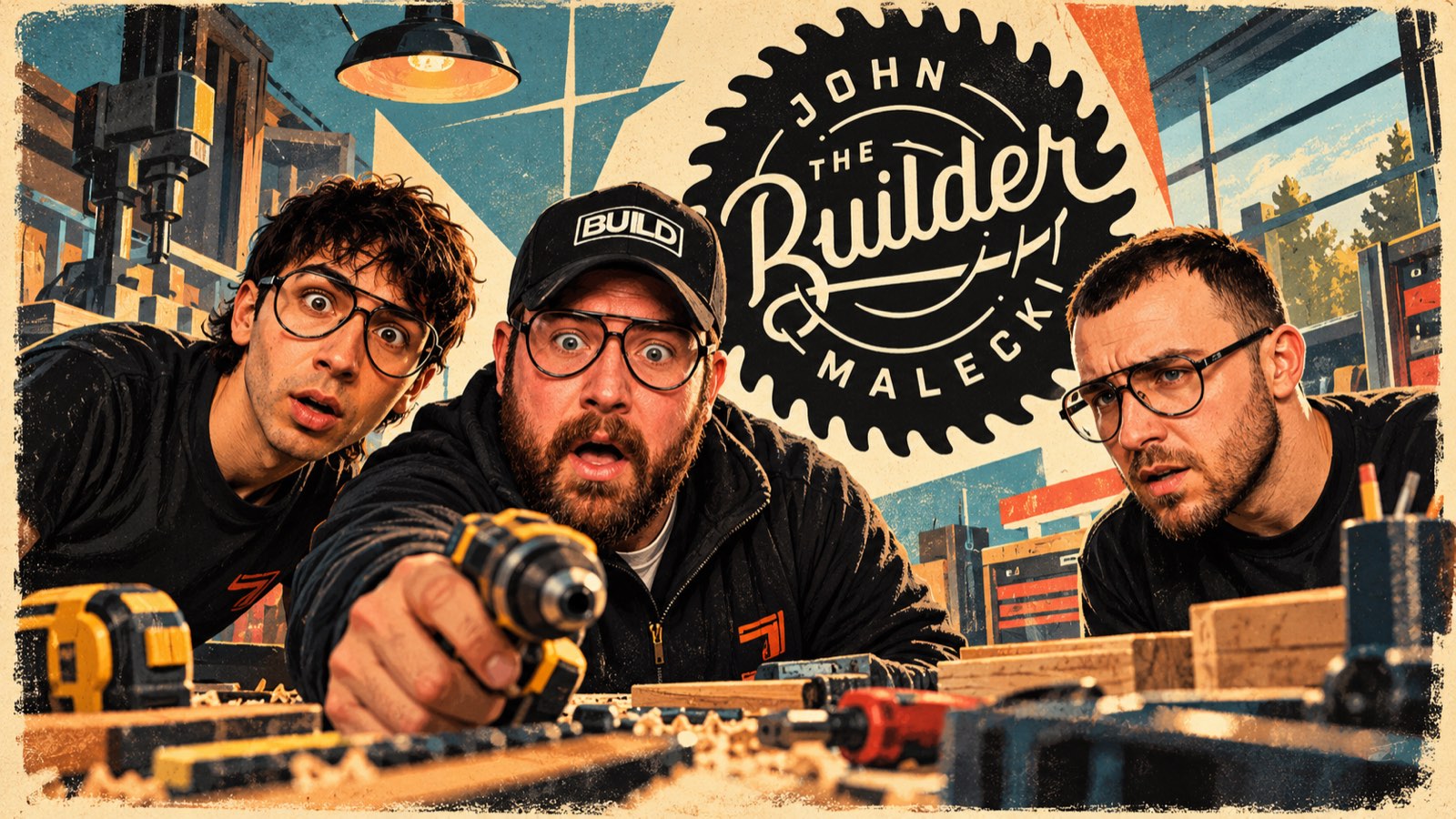
There is a dangerous side effect to watching too much John Malecki.
You start looking at your tools differently.
Then you start looking at tools you don't own.
Then somehow you're researching whether you really need another impact driver at 11pm.
You probably don't.
But that's not really the point.
It's Not Just About Woodworking
I originally found John Malecki through the sort of content YouTube knows I'm helpless against: workshops, tools, people building things and people figuring out why something didn't quite work.
John's story itself is pretty unusual. After a career as an NFL offensive lineman, he taught himself woodworking and eventually turned that interest into custom furniture, content and a much bigger maker business.
But I'm not a professional woodworker.
I'm a field service engineer.
And strangely, that's exactly why his content clicked with me.
Because underneath the enormous slabs of timber, ridiculous builds, power tools and workshop banter is something I can relate to enormously:
Not because someone is standing over you checking it.
Not because somebody is going to give you a gold star.
Because your name is attached to the result.
Workmanship Matters
That's probably the biggest influence John and the team have had on me.
Workmanship.
There's something incredibly satisfying about doing a job properly.
In my world, the finished product isn't usually a beautiful dining table sitting in someone's home. It might simply be a piece of equipment working exactly as it should again.
Most people will never know what happened behind the panels.
They won't see the diagnosis.
They won't see the awkward bolt.
They won't see the cleaning, adjustment, testing or the moment where you stop and think:
"That's not quite right."
They just see a machine that works.
But I know.
And I've increasingly realised that this matters to me.
I don't want something to merely work when I leave it. I want to be happy with the work I've done.
Watching makers like John has reinforced that mentality. His comments about looking back at old projects and seeing how much there was still to improve capture something I really like about skilled work: you're never actually finished learning.
Today's best work becomes tomorrow's benchmark.
Then you move the benchmark.
The Right Tool for the Job
And then we arrive at the expensive part.
TOOLS.
Good grief.
John once described his approach as less about having a favourite tool and more about having the right tool for the job. He talked about how better equipment made his work easier, improved the finished projects and even made the process itself more enjoyable.
That philosophy has thoroughly infected my toolbox.
I'm fascinated by tools.
Not just owning them. Understanding them.
Why has somebody designed the handle that way?
Why does that screwdriver grip the fastener better?
Why is that ratchet head thinner?
Why does one pair of safety glasses disappear on your face while another becomes annoying after twenty minutes?
Why does one tool survive years of abuse while another feels disposable straight out of the packet?
It's why I've ended up with Wera screwdrivers, Hex-Plus keys, Joker spanners, carefully chosen consumables and a rolling tool bag that could probably develop its own gravitational field.
There is a joy in finding a tool where somebody has clearly thought:
"There has to be a better way of doing this."
That's engineering catnip.
And Then There's Unscrewed…
Of course, John Malecki Unscrewed makes resisting new tools virtually impossible.
Take tools.
Test them.
Abuse them.
Push them far beyond anything resembling sensible use.
See what survives.
That's my kind of entertainment.
And it scratches another itch I've always had: I don't particularly like accepting that something is good simply because the box says it is.
I want to know why.
What makes the expensive version better?
Is the expensive version actually better?
Where does the cheaper tool compromise?
What happens when you push it?
Sometimes the answer is engineering.
Sometimes it's marketing.
Sometimes the answer is apparently to keep going until smoke comes out.
Either way, I'm watching.
That tool obsession has spilled over into Slightly Above Average too. The podcast is hosted by John Malecki, Sam Poola and Joe Meinert, and tools remain firmly part of its DNA alongside everything else they talk about. They've even revisited years of Unscrewed drill testing and dedicated episodes to the tools they think are worth spending more money on.
At this point, my YouTube algorithm never really stood a chance.
Shop Shades Probably Prove the Point
There's also a slightly ridiculous full-circle moment here.
I wear Shop Shades pretty much every day at work.
They're safety glasses that came directly from John spending years in workshops and deciding that the existing options weren't comfortable enough. He has described the idea pretty simply: safety glasses only protect you when they're comfortable enough that you'll actually wear them.
That's exactly what I love about good tool design.
Now they're part of my everyday field kit.
So the influence isn't just philosophical. I'm quite literally wearing it on my face.
Pride Isn't Perfection
There's an important distinction here.
Taking pride in your work doesn't mean never making mistakes.
If anything, watching makers has taught me the opposite.
Things go wrong.
Measurements are wrong.
Tools break.
Ideas that seemed brilliant at the beginning turn out to be spectacularly stupid halfway through.
You adapt.
You learn.
You fix it.
And next time you're slightly better.
That's probably one of the things I enjoy most about the whole maker world. The finished object is satisfying, but the process is far more interesting.
It's the same reason I enjoy diagnostics.
A fault is effectively a puzzle somebody has handed you.
Something isn't behaving the way it should.
Why?
Now go find out.
My Toolbox Has Become Part of My Craft
Over the years I've stopped seeing my tools simply as equipment supplied to complete a job.
My toolbox has become personal.
I know which screwdriver I reach for without thinking.
I know which tools have got me out of horrible situations.
I know which ones I'd immediately replace if I lost them.
There are cheap tools in there. Expensive ones. Beautifully engineered ones. Battered ones. And probably a few that I purchased after watching YouTube and have subsequently invented reasons to use.
But together they're my kit.
They're part of how I work.
And I think that's the biggest thing John Malecki and the team have reinforced for me.
Care about the work.
Care about the process.
Learn your tools.
Invest in good equipment when it genuinely makes the job better.
Question things.
Keep improving.
And when you've finished, take a second to look at what you've done and think:
And if another Wera parcel happens to arrive while I'm pursuing it…
That's between me and the delivery driver.