MythBusters: The Show That Taught Me to Ask “Why?”
Some programmes are entertaining. MythBusters quietly changed the way my brain works, and its fingerprints are all over my workshop.
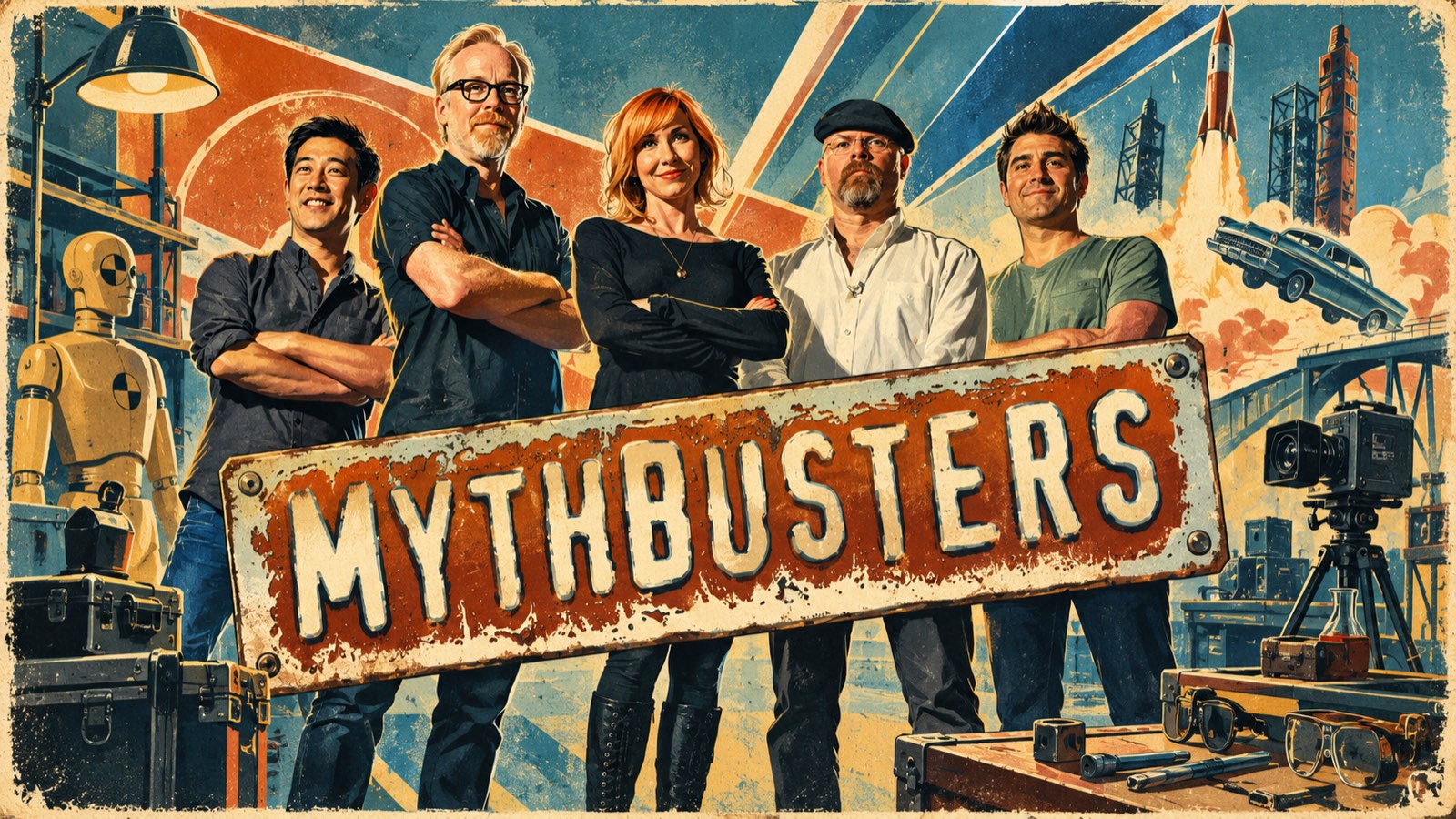
There are television programmes you remember because they were entertaining, and there are programmes that quietly change the way your brain works.
For me, MythBusters was the latter.
Growing up, I was fascinated by anything that explained how things worked. While plenty of kids were watching cartoons, I could happily spend hours watching the Discovery Channel. How It's Made was a favourite, but MythBusters grabbed hold of something different.
It didn't just give me answers.
It taught me to question the question.
Looking back now, I genuinely think it helped spark the curiosity that has followed me through my creative hobbies, projects and ultimately my career in engineering.
Could You Actually Do That?
The basic premise of MythBusters was beautifully simple.
Take something people believe to be true and test it.
The series was fronted by special-effects experts Adam Savage and Jamie Hyneman, alongside a wider build team including Kari Byron, Tory Belleci and Grant Imahara.
They took urban legends, movie scenes, internet claims, historical stories and seemingly ridiculous questions and subjected them to experimentation.
Could you really do that thing you saw in a film?
Would this actually explode?
Could something survive that impact?
What happens if you make it bigger?
What happens if you make it much bigger?
Sometimes the result was Confirmed.
Sometimes Plausible.
Quite often Busted.
But the answer was almost secondary.
The fascinating bit was figuring out how to find the answer.
Build Something and Find Out
That's the part of MythBusters that has stayed with me.
Adam and Jamie didn't sit behind a desk discussing why something theoretically should or shouldn't work.
They built it.
They tested it.
If the first experiment wasn't good enough, they changed it.
If something broke, they investigated why.
If the test couldn't reproduce the conditions properly, they built a better test.
And if a small explosion didn't provide a sufficiently convincing answer, well…
MythBusters had a fairly predictable solution to that problem.
As a kid, it was spectacular television.
As an adult working in a technical career, I realise I was also watching a very accessible form of the engineering process.
I didn't know that's what I was absorbing at the time.
I just thought blowing things up in the name of science looked brilliant.
Failure Wasn't Failure
One of the most important things MythBusters demonstrated was that getting something wrong wasn't embarrassing.
It was useful.
An experiment failing didn't necessarily mean the whole idea had failed. It meant you'd discovered something.
Maybe the assumptions were wrong.
Maybe the construction wasn't strong enough.
Maybe another variable hadn't been considered.
Maybe the test itself was flawed.
So you changed something and tried again.
That's something I recognise constantly now.
Whether I'm diagnosing equipment, learning about networking, building a website, experimenting with software or disappearing down another technical rabbit hole, the process is remarkably similar.
I don't necessarily need to know the answer when I begin.
I need to know how to start looking for it.
Adam Savage and the Joy of Being Curious
Adam Savage in particular had a huge influence on me.
There was something infectious about the way he approached making.
He wasn't afraid of being visibly excited about something.
Tools were exciting.
Materials were exciting.
A weird mechanical problem was exciting.
Discovering an obscure fact that suddenly solved a problem was exciting.
And making something purely because you desperately wanted to know whether you could was a perfectly legitimate use of your time.
That attitude has stuck with me.
I've realised as I've got older that I don't particularly enjoy staying inside one neatly labelled box.
I like engineering.
I like tools.
I like photography.
I like computers and networking.
I like designing websites.
I like building systems.
I like taking an idea that exists only in my head and gradually turning it into something I can actually use.
And I really like finding a problem and thinking:
There has to be a better way of doing this.
That sentence has caused me an unreasonable amount of additional work over the years.
I wouldn't change it.
The Question Is Often More Interesting Than the Answer
This is probably the biggest connection I can draw between watching MythBusters as a kid and the way I approach things today.
I question things.
Why does that work?
Why doesn't this work?
Why do we do it this way?
What happens inside that?
Could this be simpler?
Could I automate it?
Could I build something that does it?
What happens if I change this?
And, occasionally, the classic MythBusters question:
What happens if we take this considerably further than any sensible person would?
That curiosity can turn a five-minute thought into an entire evening of research.
One browser tab becomes six.
Six somehow becomes twenty-three.
Before long I'm reading documentation for something I hadn't even heard of three hours earlier.
But I love that process.
Because even if the original idea goes nowhere, I've usually learned something along the way.
From Watching Problems to Solving Them
There's a strange circularity to it now.
As a kid, I watched people diagnose problems, build things and figure out why something wasn't behaving the way they expected.
Today, that's a significant part of my working life.
Field service engineering involves walking up to something that isn't working and effectively being presented with a question.
Why?
Sometimes there's an obvious answer.
Sometimes there absolutely isn't.
You inspect it.
Listen to it.
Look at its history.
Test things.
Rule possibilities out.
Form a theory.
Try something.
And occasionally discover that your beautifully constructed theory was completely wrong.
So you start again.
That's troubleshooting.
But it's also exactly what fascinated me about MythBusters.
The satisfaction isn't simply fixing something.
It's the moment when the pieces suddenly connect and you understand why it wasn't working.
That's the bit I love.
Curiosity Became Creation
The other thing MythBusters helped establish was the relationship between curiosity and making.
When you repeatedly ask questions, eventually you start wanting to build things to answer them.
And once you've learned that you can build something, an entirely different door opens.
You stop looking at the world purely as a collection of finished objects and systems.
You start seeing things that can be changed.
A website isn't quite right?
Build one.
A process feels unnecessarily complicated?
Redesign it.
You need something that doesn't exist?
See if you can make it.
Something breaks?
Find out why.
Don't understand something?
Learn.
That's probably the greatest gift MythBusters gave me.
Not a particular scientific fact or memorable explosion.
I Still Want to Know Why
Years later, Adam Savage is still an influence on me, particularly through his making projects and Every Tool's a Hammer.
But I think the seed was planted much earlier.
It was planted watching two people stand in a workshop surrounded by tools, prototypes, drawings and half-finished experiments asking wonderfully unnecessary questions.
Then doing the work required to answer them.
I didn't become a special-effects designer.
I didn't build movie props.
And thankfully, my working day involves considerably less high explosive.
But that basic philosophy somehow stuck.
Ask questions.
Take things apart.
Make things.
Test your ideas.
Accept when you're wrong.
Learn something.
Try again.
I don't know whether I'd have developed the same fascination with engineering, technology and creating things without MythBusters.
Perhaps I would have.
But when I look at the way my brain works today, the constant questions, the projects, the tools, the troubleshooting and the endless desire to understand how things work, I can certainly see its fingerprints all over the workshop.
And I think that's why, all these years later, my favourite question is still the simplest one: