The Man Who Made Me Look Up
Following the engineering trail left by my grandpa, Anthony "Tony" Cleveland, from Bristol aero engines and the Olympus era to pipelines, turbo-expanders and a company sign with a daisy on it.
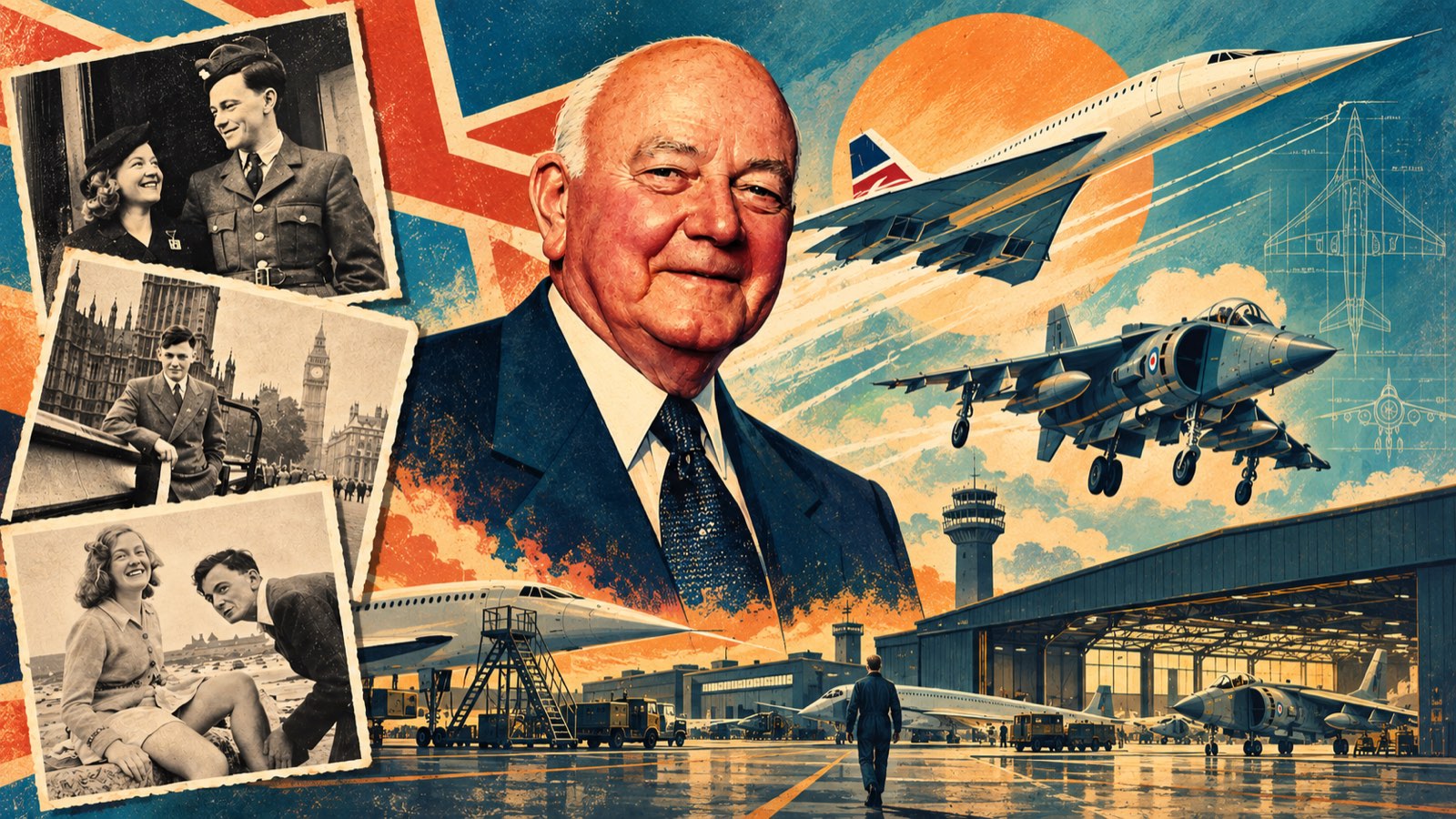
Some people leave behind possessions.
Others leave behind questions.
My grandpa, Anthony “Tony” Cleveland, left me with a curiosity about engineering that I don't think I fully appreciated until I was older.
He was born on 2 November 1926 and lived an extraordinary life that took him from Britain's post-war engineering industry to the emerging world of gas turbines, natural-gas transmission and, eventually, his own engineering consultancy in Canada.
Growing up, I knew the big family stories.
Concorde. The Harrier. British Gas. Canada. Engineering.
They sounded almost mythical when I was younger. Concorde in particular feels less like a machine and more like something Britain somehow managed to pull out of the future.
As I've got older, and as engineering has become a much bigger part of my own life, I've wanted to understand what Grandpa actually did.
Not just repeat the family story.
I wanted to follow the engineering trail.
And what I've found has made me appreciate his career even more.
Engineering the Impossible
One of the stories that has always followed Grandpa is that he worked on engines connected with Concorde and the Harrier.
His own obituary describes his UK aviation career as including the design of engines for both aircraft.
Until recently, that was about as far as I could take it.
But digging through professional engineering records has allowed me to put some much firmer foundations underneath that story.
Tony studied at the University of London between 1948 and 1951.
His later professional biographies then describe his early industry experience as being with:
Bristol aero engines.
And crucially, that sentence isn't family memory. It appears in his professional biography in two independent engineering publications, both from 2017: Gas Processing & LNG, alongside a paper on standardising compressor station design, and Pipeline & Gas Journal, alongside his article on capturing waste heat from gas compressor stations.
Both record the same career: Bristol aero engines, then Solar in the United States, then Manager of the Machinery Department at British Gas, then Canada in 1975.
That little sentence matters enormously.
Because Bristol wasn't simply another engineering company.
It was one of the great centres of British aero-engine development.
And when Tony entered that world in the early 1950s, Bristol was working on an engine family that would eventually become inseparable from one of the most extraordinary aircraft ever built.
The Olympus.
Bristol and the Olympus
The Bristol Olympus first ran in 1950, right around the time Tony was finishing university and beginning his engineering career.
Originally developed as a powerful military turbojet, the Olympus would go on to power aircraft including the Avro Vulcan.
Decades of development ultimately produced the Olympus 593, the engine used by Concorde.
So one part of Grandpa's story can now be said with much greater confidence:
That is documented history.
What I haven't yet found is the surviving piece of paper that says:
"Anthony Cleveland, Olympus Development Team."
And that's an important distinction.
Thousands of engineers contributed to Britain's aerospace industry without their names becoming readily searchable seventy years later. Staff records, departmental documents and internal engineering material often never made the transition into the digital world.
So I don't want to turn family history into something more definite than the surviving evidence allows.
What I can say is that Grandpa was there.
He was working in the Bristol aero-engine organisation.
He was a gas-turbine engineer.
And he was there at precisely the point when the Olympus family was becoming one of Britain's most significant jet-engine programmes.
That alone makes the family connection to Concorde much more substantial than I previously understood.
And Then There Is the Harrier
The Harrier story is equally fascinating.
The aircraft's ability to take off and land vertically came from another remarkable Bristol engine:
the Pegasus.
Its origins lay in Bristol's late-1950s engineering work, initially under the designation BE.53, before becoming the engine used in the Hawker P.1127, Kestrel and ultimately the Harrier.
The first Pegasus ran in 1959.
The Hawker P.1127 followed, eventually leading to the Harrier.
And once again, the important question becomes:
How long did Grandpa remain at Bristol?
That is the missing piece of the puzzle.
If Tony was still working there into the late 1950s, then the family story connecting him personally with the Pegasus and therefore the Harrier becomes chronologically very plausible.
If he had left earlier, the connection may instead come from his broader work within Bristol's gas-turbine engineering organisation.
At the moment, I don't have his exact Bristol departure date or department.
So I can't responsibly write:
"Grandpa designed the Harrier's Pegasus engine."
But neither is the Harrier connection some random piece of family folklore.
The engine that powered it came from the exact aero-engine organisation in which Tony began his career. ASME later made that engine an international engineering landmark, crediting Bristol Aero-Engines with the design, and the Olympus lineage that ended up under Concorde's wings runs through the same Bristol works, now told at Aerospace Bristol.
The documented part is that Tony worked for Bristol aero engines. The extraordinary part is where that places him historically.
That is worth preserving.
A Career Built Around Turbines
One of the things that makes the aviation story much more convincing is what Tony did afterwards.
He didn't leave Bristol and disappear into an unrelated branch of engineering.
His career remained deeply rooted in gas turbines, compressors and rotating machinery.
After Bristol, his professional biography records that he worked for Solar in the United States.
Solar itself had extensive experience in gas turbines and aircraft propulsion technology.
From there, Tony moved to British Gas, eventually becoming Manager of the Machinery Department.
His work involved the planning, design and selection of machinery for Britain's natural-gas transmission system.
The aircraft had changed into pipelines.
But the engineering language remained remarkably similar:
- turbines
- compressors
- pressure
- flow
- energy
- rotating machinery
The same fundamental engineering principles that move enormous quantities of air through a jet engine can also move enormous quantities of gas through a national transmission network.
Grandpa had found his world.
Then I Found His Name on a Paper
This is the part of the research I wasn't expecting.
I knew Grandpa was an engineer. I didn't know he had spent decades writing about it.
Then I found his name on an ASME paper.
Then another.
And another.
In 1986 he presented Energy Recovery With Turbo Expanders (paper 86-GT-66), about recovering useful energy from gas that was going to be let down in pressure anyway.
In 1988 came Turbo Expanders for Energy Recovery: Design and Installation of a 250 kW Unit (88-GT-266). Not a concept this time. Something actually installed and running.
In 1990, with T. Hugh Barmby, Control Systems for Turbo Expanders in Pressure Reduction Service (90-GT-349), presented in Brussels, with React Energy Ltd. of Calgary beside their names.
By 1993 he was writing Turbo Expanders for Power Generation: State of the Art and Design Optimization, and this one carries the line I keep going back to:
Anthony Cleveland, Cleveland Engineering Services Limited, Calgary, Alberta, Canada.
His own company. His own name. Printed in an engineering paper decades before I went looking for it.
The work carried on into 1998, when he and E. A. Wright presented Turbines & Reciprocating Engines Producing Power from Natural Gas Pressure Reductions in the Supply System to the Institution of Diesel and Gas Turbine Engineers. The institution's synopsis notes that the authors had already been working in this area for a number of years, which tells you this wasn't a passing interest. It was his subject.
Suddenly the stories I grew up hearing were sitting in engineering archives with his name printed across them.
Still Being Read
There's one more thing I found, and it's probably my favourite.
His work didn't stop being useful when he stopped publishing it.
A 2015 MSc thesis from Vienna University of Technology, on waste-heat recovery and natural-gas energy systems, names Tony Cleveland of Cleveland Engineering Services Ltd. among the researchers whose work contributed to the field.
He's not a famous name in engineering. He wasn't trying to be.
But decades after he wrote those papers, somebody studying the same problem was still reading them.
That'll do.
Canada
In 1975, Tony moved to Canada.
His engineering career continued there, including work connected with northern pipeline development before he established Cleveland Engineering Services Ltd.
He eventually became its President.
And his expertise wasn't simply something remembered by his family.
It exists in the engineering record.
Over the following decades Tony authored and co-authored professional papers covering subjects including:
- turbo-expanders
- energy recovery
- compressor stations
- gas-turbine systems
- control systems
- natural-gas transmission
In 1986, he published work on energy recovery using turbo-expanders.
Further technical papers followed in 1988, 1990 and 1993, including work on turbo-expander design, installation, control systems and power generation.
He continued publishing into the late 1990s.
His name also appears in engineering literature concerning compressor stations and natural-gas transmission.
The more I research his career, the clearer the thread becomes.
Bristol aero engines. Gas turbines. Solar. British Gas. Compressors. Pipelines. Turbo-expanders. Cleveland Engineering Services.
It wasn't a collection of unrelated jobs.
It was a lifetime spent understanding machines that move enormous amounts of energy.
Cleveland Engineering Services Ltd.

There is something else about Cleveland Engineering Services Ltd. that I love.
The company sign carried a small daisy.
She loved flowers and apparently felt the engineering company needed a little something extra.
Decades later, without knowing anything about that connection when the nickname was first given to me, my own rugby nickname became:
Daisy.
It's one of those tiny family coincidences that means absolutely nothing scientifically and absolutely everything emotionally.
An engineering company on another continent, a flower added by my Grandma, and years later the same name somehow finding its way back to me.
The Man Behind the Engineering
It would be easy to look at Grandpa's career and concentrate entirely on the machines.
Concorde.
The Harrier.
Gas turbines.
Pipelines.
Engineering papers.
But the older I get, the less interested I am in simply collecting impressive names.
I'm much more interested in the person who understood how things worked.
Because that's the part I recognise.
Not at his level, obviously.
I'm not designing gas turbines.
My engineering world is field service.
I diagnose machines.
I follow faults.
I look at systems and ask why something isn't behaving the way it should.
I take things apart.
I work through possibilities.
I repair them.
And increasingly I realise that the thing linking our careers isn't a particular machine.
It's the question:
Why has that failed?
Why was it designed that way?
Why does changing this affect that?
How could it work better?
What's actually happening inside the machine?
Those questions have followed me throughout my career.
Grandpa the Engineer, Grandson the Engineer
There is something quite strange about realising that you've drifted towards the same sort of thinking as somebody who came generations before you.
My career has taken a completely different route.
I spent years with Sky before eventually moving properly into field engineering and commercial fitness equipment.
Grandpa's machines dealt with forces and energy on an enormous scale.
Mine might be treadmills, cross trainers, strength equipment and connected fitness systems.
But fault finding is fault finding.
A system tells you a story.
You learn how to read it.
A noise means something.
A temperature means something.
A pressure means something.
A vibration means something.
An error code means something.
The machine is always giving you clues.
The engineer's job is to listen.
I think Grandpa would have understood that immediately.
The Questions I Wish I'd Asked
This is probably the hardest part of researching his career.
I have so many questions now.
What exactly did he do at Bristol?
Which department did he work in?
Did he work directly on the Olympus?
Was he still there when the Pegasus programme began?
Did he ever see Concorde and think: "There's a little bit of something I worked on in there"?
What did he think the first time he saw a Harrier hover?
What problems kept him awake at night?
Which machines frustrated him?
Which project was he proudest of?
What was his favourite tool?
Who were the engineers around him?
What did the design offices look like?
How much did they realise they were building things people would still talk about seventy years later?
When you're young, you don't think to ask those questions.
Grandparents are just Grandpa and Grandma.
Their history feels permanent.
You assume the stories will always be there.
Then one day you realise you've become old enough to understand the questions, but some of the people who could answer them aren't there anymore.
What We Know, and What We're Still Looking For
I want this story to remain honest.
So today, this is what I can actually say.
Anthony “Tony” Cleveland was a professional gas-turbine and turbomachinery engineer.
He studied at the University of London between 1948 and 1951.
His early industrial career included Bristol aero engines.
He therefore worked within Bristol's aero-engine organisation during the formative era of the Olympus, the engine family eventually developed into the Olympus 593 used by Concorde.
His family and obituary connect his aviation career with both Concorde and the Harrier.
The Pegasus engine that ultimately powered the Harrier was likewise developed by Bristol, beginning during the late 1950s.
What hasn't yet surfaced online is the staff record or technical document identifying Tony's exact Bristol department, employment dates or specific engine programme.
That search isn't finished.
The answer may still be sitting in a Rolls-Royce archive, an old Bristol staff magazine, an engineering institution membership record or a box of company papers that has never been digitised.
And strangely, I rather like that.
There's still something left to discover.
Four Generations
Family history doesn't always travel through photographs or objects.
Sometimes it travels through ways of thinking.
Grandpa's engineering career began in an extraordinary period.
Britain was developing jet engines, supersonic aircraft and machines capable of taking off vertically.
He then carried that knowledge into another enormous engineering challenge: moving natural gas across countries and recovering energy that would otherwise be wasted.
My engineering life is much smaller in scale.
But that instinct to understand the machine is there.
And I see curiosity appearing in the generation after me too.
Maybe that's the real inheritance.
Not an engine.
Not a drawing.
Not even a company name.
The Man Who Made Me Look Up
Concorde used to be the headline of Grandpa's story for me.
It isn't anymore.
The deeper I dig, the more impressive the whole career becomes.
A young engineer leaving university around 1951 and entering the world of Bristol aero engines.
The Olympus era.
Potentially the beginnings of Pegasus.
Then America.
Solar.
British Gas.
Canada.
Cleveland Engineering Services.
Decades of work on turbines, compressors and energy systems.
Technical papers still sitting in engineering archives today.
That is the story I want to preserve.
And perhaps one day I'll find that final document.
A. Cleveland. Bristol. Olympus.
Or Pegasus.
Maybe even Concorde itself.
Until then, I'm happy with the truth we've already uncovered.
My Grandpa really was part of that extraordinary generation of British engineers who worked at the beginning of the gas-turbine age.
His career touched the engineering lineage behind some of the machines that made me stare at the sky when I was younger.
And decades later, I'm still doing what he seems to have spent his life doing.
Looking at machines.
Asking questions.
Trying to understand how they work.
I just wish I'd asked him more of them.
Sources and further reading
About Tony Cleveland
- Standardize compressor station design to reduce project costs and time line — Gas Processing & LNG, 2017. Carries his professional biography.
- Capturing Waste Heat from Gas Compressor Stations — Pipeline & Gas Journal, 2017. His own article, with the same career history.
Tony's engineering papers
- Energy Recovery With Turbo Expanders — ASME 86-GT-66, 1986.
- Turbo Expanders for Energy Recovery: Design and Installation of a 250 kW Unit — ASME 88-GT-266, 1988.
- Control Systems for Turbo Expanders in Pressure Reduction Service — ASME 90-GT-349, with T. Hugh Barmby, 1990.
- Turbo Expanders for Power Generation: State of the Art and Design Optimization — ASME, 1993.
- Turbines & Reciprocating Engines Producing Power from Natural Gas Pressure Reductions in the Supply System — Institution of Diesel and Gas Turbine Engineers, paper 505, with E. A. Wright, July 1998.
Aviation history
- Pegasus 3 engine, BS 916 — ASME international historic engineering landmark, on Bristol Aero-Engines and the engine behind the Harrier.
- The story of Concorde — Aerospace Bristol, on Bristol, the Olympus and Concorde.
Later recognition
- MSc thesis on waste-heat recovery and natural-gas energy systems — Vienna University of Technology, 2015, which names Tony among researchers in the field.
PART OF THIS STORY
- Alan John Lock: Built Through ExperienceThoughts · 20.09.26
- Before I Had a Toolbox, I Had WoodleyThoughts · 20.09.26
- Carroll Shelby: Cobras, Mustangs, GT40s and a Life Built Around Making Things BetterThoughts · 18.09.26
- The Future We Were PromisedThoughts · 18.09.26
- Guy Martin: Curiosity, Engineering & Getting Stuck InThoughts · 17.09.26