Before I Had a Toolbox, I Had Woodley
Growing up among aircraft, woods, pillboxes and the remains of another world. An ordinary Berkshire town with an aerodrome underneath it, and a childhood spent climbing into things to find out what they were.
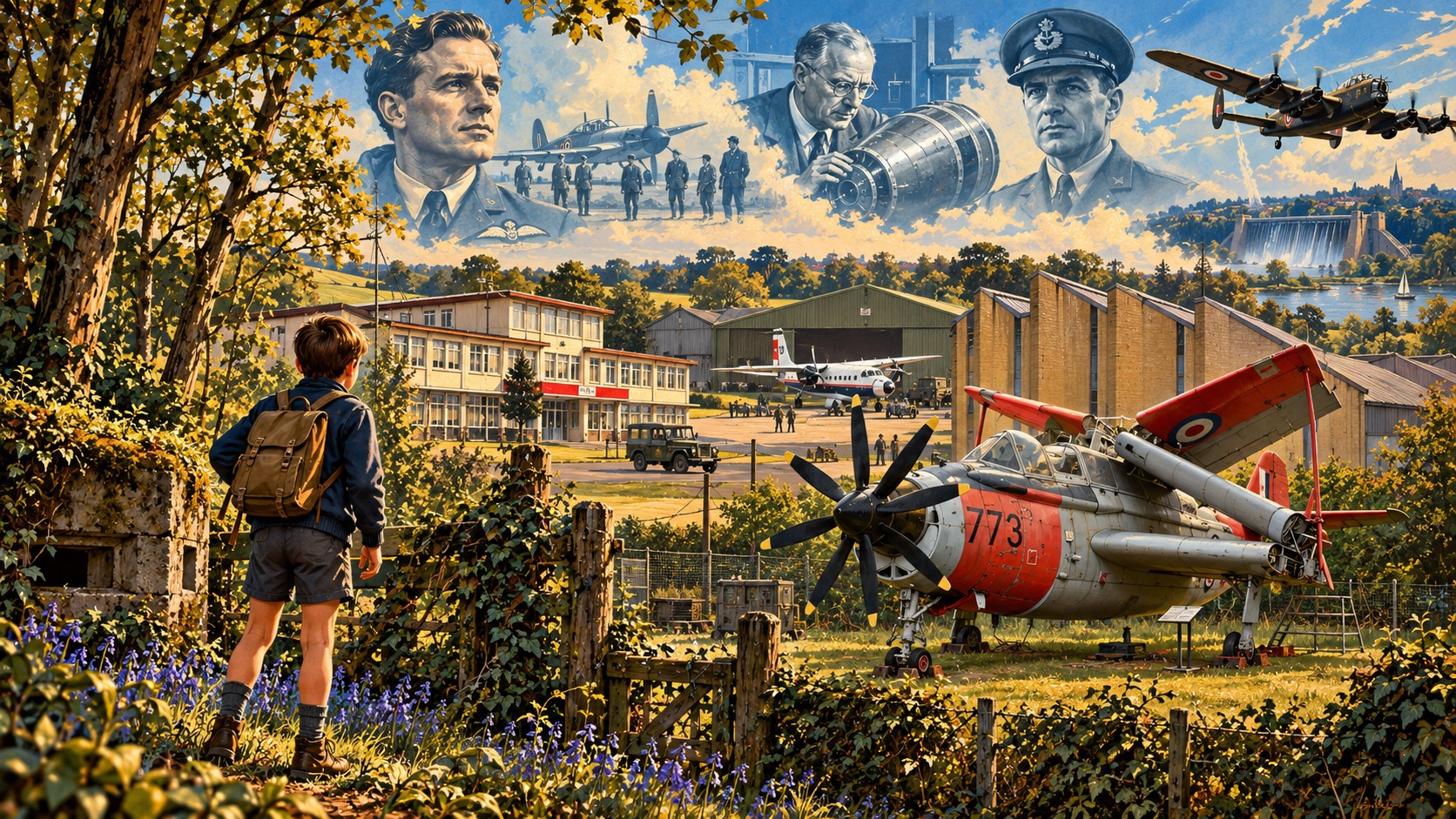
I can't remember exactly when I first heard the name Douglas Bader.
Growing up in Woodley, Berkshire, it was almost impossible not to.
But somewhere along the way, knowing the name wasn't enough.
I wanted the whole story.
I became obsessed with finding out everything I could about him. I learned about the crash, the loss of his legs, his determination to walk again and his fight to get back into an aircraft.
And I watched Reach for the Sky constantly.
Kenneth More's portrayal of Bader became part of my childhood. It was one of those films I could watch again and again, despite already knowing exactly what was going to happen.
The strange thing was that when the film finished, I could go outside.
Because the beginning of Bader's extraordinary story hadn't happened somewhere distant.
It had happened in Woodley.
And I was growing up amongst what remained.
The history beneath my feet
To me, Woodley was simply home.
It was Rivermead Primary School and later Waingels Copse.
It was riding bikes, disappearing into the woods and exploring.
It was Dinton Pastures.
It was the place we called Bluebell Woods.
It was finding old concrete structures amongst the trees and trying to work out what they were.
It was the Museum of Berkshire Aviation.
I didn't appreciate it at the time, but the ordinary suburban town around me had another Woodley underneath it.
An aerodrome.
An aircraft factory.
An RAF flying school.
A wartime defensive network.
A place where aircraft had been designed, built, tested, repaired and flown.
And occasionally that older Woodley quite literally came back out of the ground.
Reading Aerodrome
Reading Aerodrome opened at Woodley in 1929.
Within weeks there was a flying school. Alan Cobham's famous flying circus visited and, in 1930, an air fête reportedly attracted around 20,000 people.
This quiet piece of Berkshire countryside was rapidly becoming somewhere important in British aviation.
Eventually it became home to Miles Aircraft, and Woodley developed into a serious centre of aircraft design and manufacture.
Amy Johnson visited.
Charles Lindbergh visited and flew a prototype Miles aircraft.
Aircraft were designed there.
Pilots trained there.
During the Second World War, thousands of people would eventually work around the site.
But one event in 1931 would forever connect Woodley with one particular pilot.
Douglas Bader
On 14 December 1931, a young RAF pilot named Douglas Bader arrived at Woodley flying a Bristol Bulldog.
He attempted low-level aerobatics.
The aircraft's wing struck the ground.
The crash was catastrophic.
Bader was taken to the Royal Berkshire Hospital, where his injuries ultimately resulted in the loss of both legs.
That could easily have been the end of his flying career.
Instead, it became the beginning of the story that fascinated me.
Within months Bader had learned to walk using artificial legs.
Then he wanted to fly again.
Initially the RAF wouldn't allow it. He eventually left the service.
But as another war approached, Bader kept trying.
He returned to the RAF, passed the necessary flying tests and eventually flew Spitfires operationally during the Second World War.
Then he was shot down.
He became a prisoner of war.
He repeatedly tried to escape.
Eventually he ended up in Colditz.
At one point the RAF even parachuted a replacement artificial leg into occupied Europe for him.
As a kid, I thought this story was incredible.
Aircraft were obviously part of the attraction.
But looking back, I think there was something else buried inside it.
Something had gone catastrophically wrong.
Bader couldn't undo what had happened.
So he adapted.
He learned.
And he found another way.
Reach for the Sky
The story came alive for me through the 1956 film Reach for the Sky, with Kenneth More playing Bader.
I watched it constantly.
It wasn't documentary history, and I've learned much more about the real Bader as I've grown older.
But as a child, the film opened a door.
And the extraordinary thing was that I was watching a story connected directly to the place where I lived.
Bader's accident wasn't something that had happened on some anonymous RAF base hundreds of miles away.
It happened here.
Woodley continued to remember him.
There was Bader Way.
And travelling along it could take you towards another place that became incredibly important to me.
The Museum of Berkshire Aviation
I loved the Museum of Berkshire Aviation.
I spent hours there.
Aircraft.
Engines.
Instruments.
Photographs.
Bits of machinery.
Stories about pilots and engineers.
As a kid, you don't necessarily stand beside an aircraft thinking about its industrial or technological significance.
You look at it and wonder:
How does that work?
Why is that shaped like that?
What does that control do?
How can something that heavy fly?
Who built it?
The wonderful thing about the museum was that this wasn't a random collection of aircraft transported to Woodley.
It existed because of what had happened in Woodley.
The museum opened in 1993 on part of the historic aerodrome site.
Its collection preserved the aviation history of Berkshire, including aircraft associated directly with Miles and Woodley.
Some had been made there.
Some had flown there.
Some had crashed in Berkshire.
The museum was effectively explaining the history of the landscape outside its own doors.
I just didn't realise how much of that landscape I was already exploring.
Finding the war in the woods
I was always outside.
One of my favourite places was the woodland we knew as Bluebell Woods.
I'd disappear into the trees and explore.
And every so often you would find something.
Concrete.
A strange structure.
A pillbox.
An air-raid shelter.
To a child, these things were brilliant.
They were bunkers.
Forts.
Places to climb into and explore.
You didn't necessarily stop to contemplate why somebody had poured several tons of reinforced concrete into the Berkshire countryside.
You just wanted to see what was inside.
Only much later did I understand that these weren't isolated oddities.
They were pieces of a much larger defensive landscape.
The pillboxes
There are still Second World War pillboxes around the River Loddon.
Wokingham Borough Council's own landscape history identifies them specifically as remnants of the defences constructed to protect Reading Aerodrome at Woodley.
At least three have been recorded around the Loddon.
One survives beside the aviation museum.
There was even a dedicated Airfield Battle Headquarters, part of the infrastructure intended to coordinate the defence of the aerodrome if enemy troops attacked it.
Suddenly those mysterious concrete structures from my childhood have a completely different meaning.
We weren't simply playing around abandoned bunkers.
We were exploring the remains of the system built to defend one of Britain's wartime aviation centres.
And apparently generations of Woodley children did exactly the same thing.
One local resident later recalled playing around the pillbox near the museum as a child, finding .303 ammunition near the Loddon and even discovering an old rifle that was eventually taken away by the police.
For children growing up after the war, the military landscape gradually became a playground.
By my generation, nature had begun reclaiming it.
But it was still there.
The air-raid shelters
The shelters weren't imaginary either.
Historical records show shelters surviving around Woodley long after the war.
One still survives at Hurricane Way.
Others have occasionally been rediscovered beneath gardens.
And then there's Waingels.
I attended Waingels Copse School, now Waingels College.
While researching this article, I discovered an extraordinary document in the Royal Berkshire Archives catalogue.
Its reference is C/CL/L2/286.
It records a contract from 1940 for the construction of five surface-type air-raid shelters at a school recorded as Waingels Copse Secondary School.
There are still questions about how that wartime school relates institutionally and geographically to the later Waingels I attended, and I don't want to pretend we have answers that the surviving online records don't give us.
But there it is in the archive.
Five shelters.
Another layer of history attached to somewhere I knew simply as school.
Even the name Waingels Copse was telling me something
There is another layer underneath that.
Waingels Copse wasn't simply a school name.
It was once an actual wood.
Old maps show Waingels Copse on one side of Waingels Road and Norris's Copse on the other.
Waingels Copse was eventually cleared for school playing fields.
Part of Norris's Copse survives as ancient woodland, including coppiced oak and hazel.
Once again, the landscape I knew as a child was sitting on top of something older.
Woodland became school.
Airfield became housing.
Military defences became dens.
And industrial landscapes became nature reserves.
Dinton Pastures
Then there was Dinton Pastures.
To me, Dinton was somewhere to explore.
Water.
Woods.
Paths.
Fields.
Lakes.
It felt natural.
What I didn't understand as a child was that even Dinton was partly an engineered landscape.
Much of the land had once belonged to High Chimneys Farm.
Then came years of gravel extraction.
That industrial activity created the lakes that now define Dinton Pastures.
After around fourteen years of extraction, the country park opened to the public in 1979.
Nature had taken an industrial landscape and adopted it.
I love that idea now.
Because it seems to describe so much of the Woodley I remember.
A secret wind tunnel
The deeper I've researched Woodley as an adult, the more extraordinary it has become.
During the Second World War, Miles wanted a wind tunnel.
Government approval wasn't forthcoming.
So one was constructed anyway.
Secretly.
Behind farm buildings at Davis Farm.
The wind tunnel became part of the experimental engineering work taking place around Woodley.
And remarkably, it survived until 1986.
It wasn't ancient history.
The thing was still standing within living memory of the Woodley I knew.
And the work being done around it was sometimes astonishing.
Woodley tried to break the sound barrier
One of the most extraordinary projects connected with Miles was the M.52.
During the war, engineers were working on an experimental aircraft intended to investigate supersonic flight.
Think about that.
In the same town where I would later wander through woods looking for pillboxes, engineers had been working on the problem of travelling faster than sound.
Wind-tunnel models were built.
Experimental aerodynamic ideas were investigated.
Existing aircraft were modified to test concepts.
The project was eventually cancelled before the full aircraft flew.
But parts of that work survive.
And some of them ended up in the Museum of Berkshire Aviation.
So there's every possibility that as a child I walked past pieces of Britain's attempt to develop a supersonic aircraft without having the faintest idea what I was actually looking at.
I love that.
Making aircraft at scale
Woodley wasn't simply experimenting.
It was manufacturing.
During the war, Miles operated around the clock.
Aircraft moved through production.
Workers arrived by specially provided buses.
Men and women worked across the factory.
Miles also held a contract for the repair and servicing of Spitfires.
Hundreds of Miles Masters were delivered to RAF flying schools.
Woodley was a place where people made things.
Not decorative things.
Machines.
Complicated machines.
Machines that had to work.
And when they didn't, somebody had to understand why.
That feels very familiar to me now.
Barnes Wallis
Douglas Bader wasn't my only childhood aviation fascination.
There was Barnes Wallis.
And the bouncing bomb.
Again, films played a huge part in bringing the story alive for me.
I loved The Dam Busters.
But what fascinated me wasn't simply the raid itself.
It was the engineering.
The problem seemed impossible.
Germany's dams were heavily defended.
Conventional approaches weren't working.
Various ideas had been considered.
Then Wallis approached the problem differently.
What if you could make the weapon bounce across the surface of the water?
It sounds absurd.
Until somebody makes it work.
Try it. Fail. Change it. Try again.
This is the part of the Wallis story that resonates most with me now.
There wasn't one glorious lightbulb moment followed immediately by success.
There were ideas.
Calculations.
Models.
Experiments.
Failures.
Rejections.
Changes.
More experiments.
Eventually the weapon that became Upkeep emerged.
It was spun backwards before being released.
The spinning cylinder bounced across the water, helping it cross defensive obstacles before reaching the dam.
Then it sank alongside the structure before detonating underwater.
The solution wasn't obvious.
That was precisely the point.
Wallis had looked at the problem differently.
Sixty feet
Then came another problem.
How do you fly a Lancaster over water at night and reliably know that you're exactly 60 feet above it?
The solution was wonderfully simple.
Two spotlights.
One mounted forward.
One aft.
The beams were angled so that when the aircraft reached the correct height, the two pools of light converged on the water.
Two circles become one.
Sixty feet.
I love engineering like that.
Not because it's complicated.
Because it isn't.
It's a complicated problem solved with an elegantly simple idea.
Guy Gibson
Then there was Guy Gibson.
He commanded the newly formed 617 Squadron.
The crews trained relentlessly for the mission that became Operation Chastise.
Gibson's surviving logbook even records him practising:
SPOTLIGHT FLYING AT 60 FT AT NIGHT.
Suddenly all the experimental engineering had to work in the real world.
Nineteen modified Lancasters departed RAF Scampton on 16 May 1943.
The Möhne and Eder dams were breached and the Sorpe damaged.
But the cost was enormous.
Eight Lancasters were lost.
Fifty-three aircrew were killed.
People downstream were killed too, including civilians and forced labourers.
That's part of the story I understand much more clearly as an adult than I ever could have as a child.
History becomes more complicated when you grow up.
You can admire extraordinary engineering and courage while also recognising the terrible context in which they were used.
The Dam Busters
Like Reach for the Sky, The Dam Busters was one of the films that brought these stories into my childhood.
Michael Redgrave's Barnes Wallis wasn't simply fighting a war.
For much of the film he was trying to solve a problem.
That fascinated me.
Draw something.
Build something.
Test it.
Watch it fail.
Work out why.
Change it.
Try again.
I didn't know the phrase engineering process.
I just thought it was brilliant.
Looking backwards now, perhaps that tells me something.
When the war came back out of the ground
Then, in October 1999, Woodley's history suddenly became very real again.
Construction workers discovered an enormous unexploded German bomb close to the Reading–Paddington railway.
It weighed around 1,000 kilograms.
The railway was closed.
Thousands of people were evacuated.
Seven local schools were reportedly closed.
I remember the bomb discovery from my school years and associate the event strongly with my time at Waingels.
But there's an extraordinary part of the story that I only discovered while researching this article.
Another Woodley child may have watched that bomb fall.
Fifty-eight years underground
Noel Chappell was thirteen during the war.
In 1941 he remembered watching four German bombs fall around Woodley.
Two exploded.
Two apparently disappeared.
He insisted there had been four.
His father apparently thought he must have been mistaken.
He wasn't.
One unexploded bomb was eventually discovered decades later.
And in 1999 another enormous bomb emerged from the ground.
Chappell was still alive.
He was evacuated.
Imagine that.
As a thirteen-year-old boy, you watch a bomb fall from an enemy aircraft and disappear into the ground.
Fifty-eight years later, somebody digs it up.
And you have to leave your home because of it.
For me, that story captures Woodley perfectly.
The war had finished decades before I was born.
But Woodley hadn't quite finished with the war.
Rivermead
Before Waingels, I went to Rivermead Primary School on Loddon Bridge Road.
I've deliberately resisted trying to retrofit my adult interests onto my primary-school education.
I can't point to one lesson at Rivermead and say:
That's why I became curious.
Human beings don't work like that.
What I can remember is the kind of child I was.
I wanted to explore.
I wanted to know things.
I wanted to understand what I was looking at.
And outside the school gates was an extraordinary environment in which to do it.
The River Loddon.
The woods.
Dinton.
The remains of the airfield.
The pillboxes.
The museum.
There was always something else to find.
The freedom to explore
I think this might be the part I value most.
We went outside.
There wasn't an itinerary.
Nobody gave me a guided tour of Bluebell Woods.
I explored them.
A path disappearing between the trees was enough reason to follow it.
Finding some strange concrete structure meant climbing around it and trying to work out what it was.
Dinton Pastures wasn't an educational exercise.
It was somewhere enormous to disappear into.
And perhaps that freedom was important.
Because curiosity needs somewhere to go.
It's difficult to learn to ask:
What's over there?
if you're never allowed to go and look.
The pattern I couldn't see
I don't want to rewrite my childhood from the perspective of the adult I became.
I certainly wasn't eight years old standing beside a pillbox thinking:
This experience will prove invaluable when I eventually become a field service engineer.
But looking backwards, there is a pattern.
Douglas Bader fascinated me.
Something catastrophic happened.
He adapted.
Barnes Wallis fascinated me.
The conventional solution wasn't working.
He experimented until he found another.
Miles Aircraft fascinated me.
People were designing, testing and manufacturing machines.
The museum fascinated me.
People were preserving and rebuilding those machines.
The woods fascinated me.
There was always something else to discover.
And the questions behind all of those things were remarkably similar.
What is that?
Why is it like that?
How does it work?
What happens if we do this instead?
Can it be fixed?
Can it be better?
Those questions never really went away.
Different machines. Same questions.
Today the objects are different.
A piece of fitness equipment with a fault.
A network that won't communicate.
A website that doesn't quite do what somebody needs.
A stock-management process that could work better.
An app idea.
A camera.
A tool.
A computer.
Some frustrating process that makes me wonder why everybody has accepted doing it that way.
My instinct is usually the same.
Understand it.
Take the problem apart.
Find the bit that doesn't make sense.
Try something.
See what happens.
Change it.
Try again.
Maybe that instinct was always there.
But Woodley certainly gave it plenty of exercise.
My first workshop
Today I describe this website as my workshop rather than my portfolio.
It's where I collect things I've built, things I've learned, people who have influenced me and ideas I haven't finished with yet.
But perhaps it isn't my first workshop.
My first one was much bigger.
It had an old aerodrome underneath it.
There were aircraft in a museum.
There were pillboxes beside the river.
There were shelters hidden around the town.
There were woods to disappear into.
There were lakes at Dinton.
There were stories about pilots.
There were stories about engineers.
There were machines that had been built there.
There were experiments that hadn't worked.
There were ambitious ideas that almost had.
There were even bombs still waiting underground to remind everyone that the past wasn't quite as far away as it seemed.
I don't know whether growing up in Woodley made me curious.
I suspect I probably already was.
But it gave that curiosity an extraordinary place to go.
Before I learned how to fix things, I learned to wonder how they worked.
And long before I had a toolbox,
I had Woodley.
PART OF THIS STORY
- NetworkChuck: Curiosity, Networking and Learning in PublicNetworking · 20.09.26
- Alan John Lock: Built Through ExperienceThoughts · 20.09.26
- The Future We Were PromisedThoughts · 18.09.26
- The Man Who Made Me Look UpThoughts · 16.09.26