The Future We Were Promised
There is something about the 1950s that has always sung to me. Not the decade itself — their idea of the future, and the confidence that somebody would go and build it.
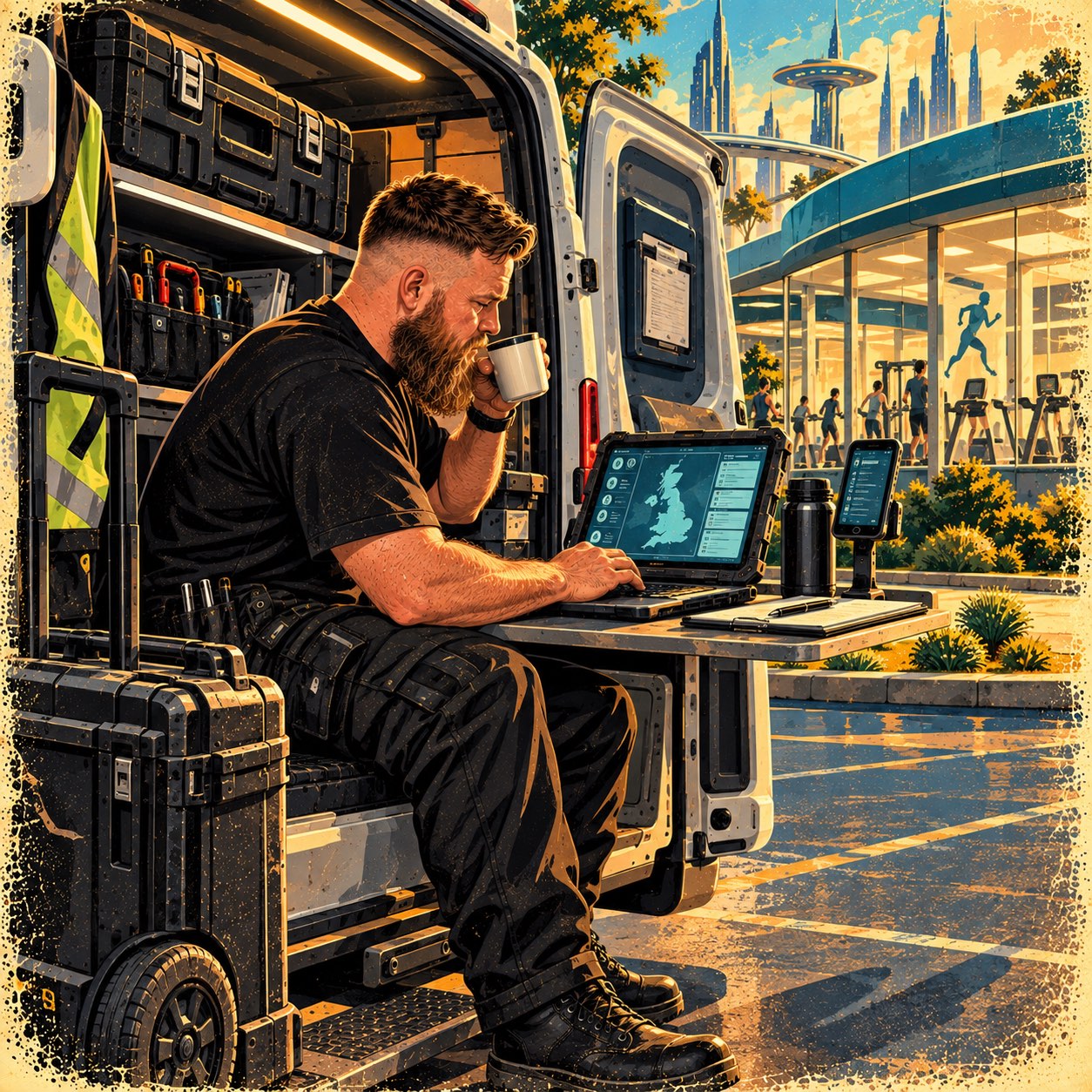
There is something about the 1950s that has always sung to me.
Which is slightly inconvenient, considering I wasn't actually there.
I didn't grow up surrounded by Bakelite radios, drawing boards and optimistic illustrations of families casually commuting to work in nuclear-powered flying cars.
But somehow, the era has always felt familiar.
Part of that connection is personal.
My dad was born in the 1950s.
And when I look at the machines, illustrations, engineering and ideas that came out of that period, I feel connected to the world his generation was born into.
But there's something else.
The thing I really love about the 1950s isn't the past.
It's their idea of the future.
Anything Felt Possible
Look at how the future was illustrated during that period.
Cities floating above the ground.
Atomic power.
Jet aircraft.
Monorails.
Robots doing the housework.
Cars with fins that looked more at home on a runway than the M6.
Holiday resorts on the Moon.
Entire magazines dedicated to explaining the machines that might exist tomorrow.
Some predictions were remarkably accurate.
Others were completely bonkers.
That's almost beside the point.
What fascinates me is the confidence behind them.
There seemed to be this wonderful assumption that problems were there to be solved.
If something didn't exist yet, somebody would invent it.
If we couldn't reach somewhere, we'd build a machine that could.
If something wasn't fast enough, we'd add another engine.
And probably some fins.
The Drawing Board
This is the part that really gets me.
Much of that extraordinary engineering began without CAD, cloud computing, or instant access to practically every piece of human knowledge through something sitting in your pocket.
It started at a drawing board.
Pencils.
Paper.
Slide rules.
Calculations.
Models.
Machining.
Testing.
And inevitably:
"Well, that didn't work."
Then another drawing.
Another prototype.
Another attempt.
I love that.
Because despite all the technology surrounding us now, that process hasn't really changed.
The tools have changed.
The curiosity hasn't.
When Machines Looked Like Machines
There's also something wonderful about the industrial design of the period.
Machines weren't desperately trying to disappear.
Switches looked like switches.
Dials looked like dials.
Equipment had labels, serial plates, warning markings and enormous mechanical controls that gave a satisfying CLUNK when you operated them.
You could often look at something and begin to understand what it did.
That's probably why old technical manuals appeal to me so much too.
Cutaway drawings.
Exploded diagrams.
Numbered components.
Arrows everywhere.
Little illustrations showing someone confidently dismantling a machine while wearing a shirt and tie for reasons nobody seems to question.
There was information in the design.
And there was personality.
Then We Started Building the Impossible
The 1950s also sit at the beginning of an extraordinary period of engineering.
The jet age was exploding.
Computers were beginning their transformation from enormous specialist machines into something that would eventually change almost every part of our lives.
The Space Race was beginning.
Automotive design became increasingly adventurous.
Aviation pushed faster and higher.
And within the decades that followed, engineers would produce machines that still seem slightly ridiculous today.
Concorde.
The Harrier.
The Saturn V.
Machines that make you stop and wonder how somebody managed to convince everyone else:
"Yes. This is absolutely achievable."
That feeling has always fascinated me.
And there's another family connection there.
My grandpa, Anthony Cleveland, spent his career in engineering, including work connected with aero engines before eventually building a career around rotating machinery and energy systems. That's a story of its own.
So when I look at that period of engineering history, it doesn't feel completely abstract.
There are little threads running through my own family.
My grandpa working with machinery.
My dad being born into that generation.
And several decades later, me still being fascinated by machines, tools, engineering and figuring out how things work.
Different workshop.
Same curiosity.
The Future According to 1958
That's ultimately where the visual identity of this site came from.
I didn't want a conventional modern portfolio.
White background.
Huge photograph.
A paragraph explaining that I'm a "passionate multidisciplinary professional".
Three immaculate project cards.
Contact me.
Done.
There's absolutely nothing wrong with that.
It just isn't me.
I wanted this site to feel like someone in 1958 had been asked to design my website for 2026.
What would they think a digital workshop looked like?
Probably control panels.
Labels.
Technical diagrams.
Drawers.
Status indicators.
Equipment tags.
Big optimistic illustrations.
Machines with considerably more buttons than necessary.
So that's the world I've tried to build.
Cream.
Mustard.
Burnt orange.
Teal.
Faded blue.
Deep navy.
Painted illustrations.
Mid-century typography.
Technical labels.
Workshop references.
Little pieces of old engineering language sitting underneath modern technology.
Not because I want the internet to look old.
Because I love imagining what the future looked like before we got here.
Retro-futurism, Not Nostalgia
There's an important distinction.
I'm not pretending everything was better in the 1950s.
It wasn't.
And I'm certainly not trying to recreate the decade.
What interests me is something much narrower.
The optimism surrounding engineering, science and the future.
That beautifully naive idea that technology might make almost anything possible.
Retro-futurism lets me borrow that optimism without pretending the past was perfect.
It lets me take the visual language of yesterday's tomorrow and use it to document what I'm actually doing today.
A field-service project.
A website.
A Wera screwdriver.
A networking lab.
A hockey club.
A netball system.
A story about my grandpa.
A Ford GT40.
They shouldn't really belong on the same website.
Yet somehow, here they do.
My Version of a Workshop
The more I've built this site, the less I've thought of it as a portfolio.
It's becoming a workshop.
There are finished things sitting on shelves.
There are projects still on the bench.
There are tools I use every day.
There are ideas stuffed into drawers.
There are people whose work changed how I think.
And there are several things I'm currently learning that I absolutely do not understand properly yet.
Good.
That's exactly how I want it.
Built From Curiosity
Maybe that's why this whole era resonates with me so strongly.
Behind all those ridiculous illustrations of Moon bases and nuclear-powered cars was a very simple question:
What if?
What if we could go faster?
What if we could fly higher?
What if computers became smaller?
What if ordinary people could own this technology?
What if we could go to space?
What if we built it?
That question has followed me through practically everything I enjoy.
Taking things apart.
Fixing machines.
Buying far too many tools.
Building websites.
Learning networking.
Coaching.
Photography.
Field service.
Writing.
Making things.
And repeatedly starting projects because I've convinced myself:
"Surely I can figure that out."
Sometimes I can.
Sometimes I make an absolute dog's dinner of it first.
But that's usually where the interesting bit starts.
The Future We Were Promised
The future imagined in the 1950s never really arrived.
We don't commute by jetpack.
There isn't a robot making my tea.
My van stubbornly refuses to become atomic-powered.
And I'm still waiting for somebody to sort out those Moon holidays.
But perhaps the most important part of that future did arrive.
We have access to tools those engineers could barely have imagined.
I can design something, write software, learn about a completely unfamiliar subject, model an idea, publish it and show it to somebody on the other side of the planet using a machine I can carry under one arm.
That's extraordinary.
So this site isn't really nostalgic for the 1950s.
Quite the opposite.
It's about taking a little of the optimism that I associate with that era and pointing it forwards again.
My dad's generation was born into a world staring towards the future.
My grandpa's generation helped engineer pieces of it.
And here I am, in my own much smaller way, still fascinated by the same basic idea.
There is always another problem to solve.
Another machine to understand.
Another skill to learn.
Another thing to build.
Another ridiculous idea sitting in the drawer.
And every now and then, one of those ridiculous ideas might actually work.
Built from curiosity. Made with purpose.
And probably modified again tomorrow.
RELATED PROJECT
- This WebsitePROJECT_010 · ACTIVE
PART OF THIS STORY
- The Man Who Made Me Look UpThoughts · 16.09.26
- Websites With a PersonalityWeb Development · 16.09.26