Alan John Lock: Built Through Experience
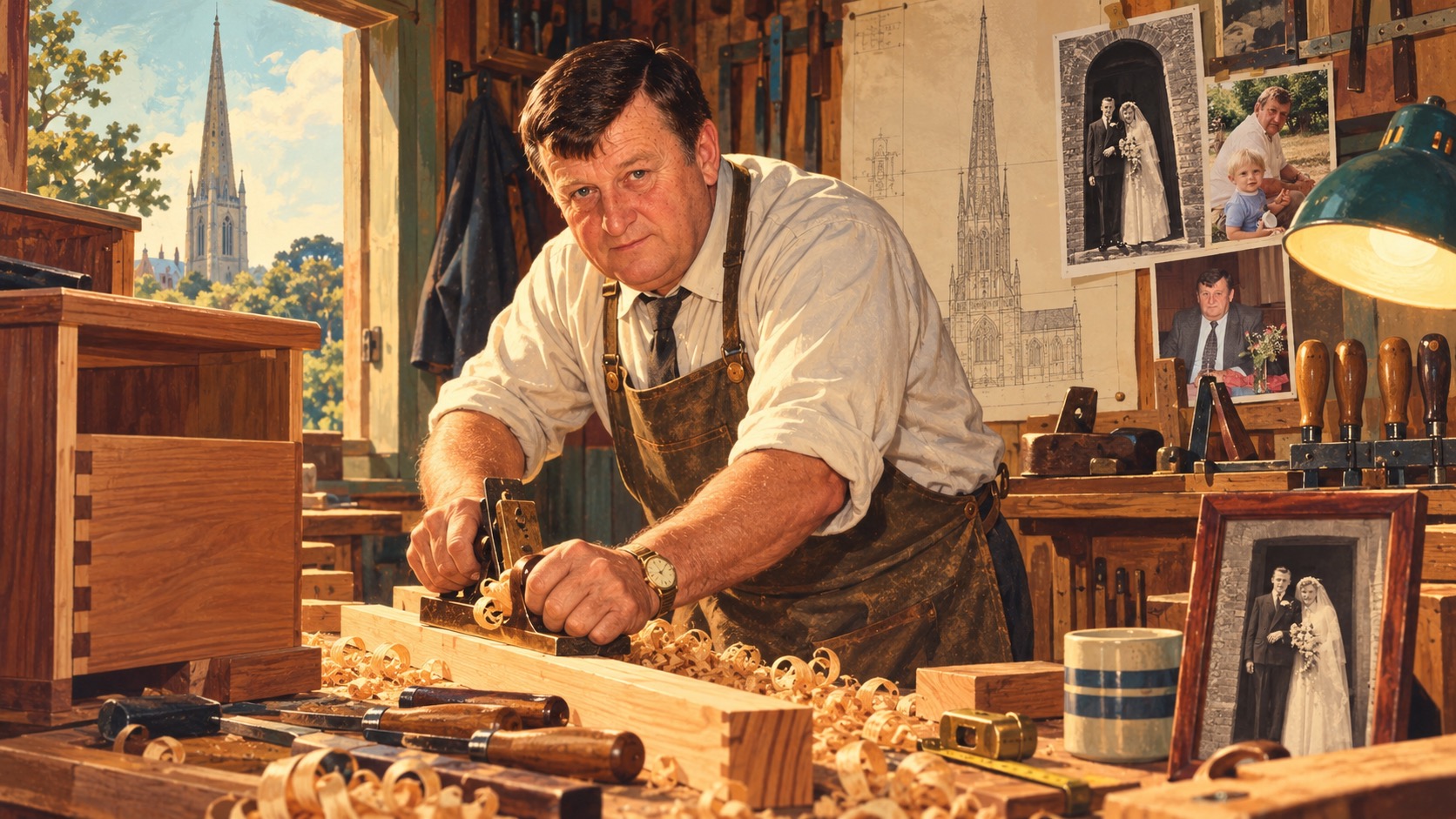
My grandad left school at fifteen and learned his trade in a workshop. Cabinet maker, carpenter, building inspector, and eventually overseas development work in Botswana, Malawi and Nigeria. Also, a door that apparently didn't fit.
17 June 1930
There are some people in your family whose influence is obvious while you're growing up.
And there are others you begin to understand properly much later.
My grandad, Alan John Lock, is becoming one of those people for me.
I knew pieces of his story. I knew he had worked with his hands. I knew he'd lived overseas. I knew there were stories about Africa and Salisbury Cathedral.
But it wasn't until I started asking questions about his life that I began to see the thread running through it.
And, unexpectedly, how familiar that thread felt.
Leaving school at fifteen
Grandad was born on 17 June 1930.
He left school at fifteen.
There was no university degree waiting for him and no carefully constructed career plan. His education continued in a different place.
The workshop.
He became a cabinet maker, remembered by my gran as working for a company called Elliotts.
Cabinet making is a trade built around precision. Measuring, cutting, joining, understanding materials and learning how something needs to be constructed before you start making it.
It was the beginning of a working life that would eventually take him considerably further than I suspect that fifteen-year-old boy could have imagined.
But before Africa, hospitals and government development work, there was a door.
And apparently it didn't fit.
The Weather Door
One of the stories my gran remembers about Grandad is that he made a door for Salisbury Cathedral.
Not just any door, either.
Our family believes it was the Weather Door, high on the north face of Salisbury Cathedral's spire.
And according to Gran, Grandad didn't get the measurements quite right.
The door didn't fit.
I absolutely love this story.
Partly because it is funny, but mainly because it makes his working life real.
When we remember previous generations, there can be a temptation to turn them into flawless characters. Every project becomes impressive. Every decision becomes wise. Every piece of work becomes perfect.
That's not how people actually learn a trade.
You make things.
Sometimes they work.
Sometimes they don't.
Then you work out why.
Researching the story has made it even more fascinating.
Salisbury Cathedral underwent major work on its spire between 1949 and 1951, when Grandad would have been around nineteen to twenty-one years old. The Cathedral archive contains an extensive photographic record of the work, including an image specifically catalogued as the Weather Door.
I haven't yet found the document that says Alan John Lock made this door, so I don't want to turn a family memory into a historical fact simply because I want it to be true.
But the pieces are intriguing.
Grandad was the right age.
He was a woodworker.
He was living and working around Salisbury.
And the family story has remembered not simply "a door at Salisbury Cathedral", but a very particular little door hundreds of feet above the ground.
The research continues.
I really hope that one day I can prove it.
Alan John Lock, Quidhampton
There is another little piece of history that may have brought Grandad unexpectedly back to life.
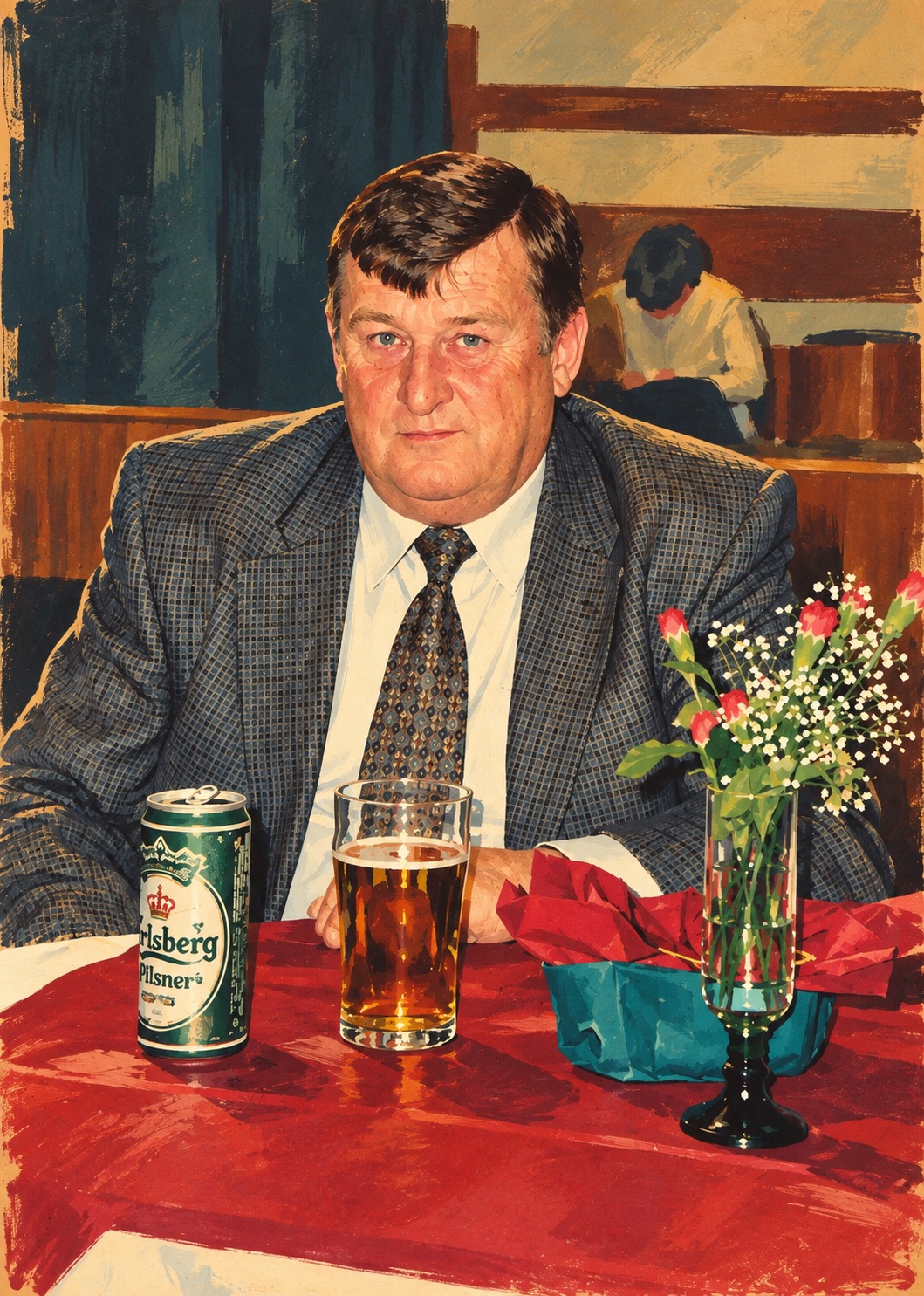
A contemporary Salisbury newspaper from March 1953 records an Alan John Lock, aged 23, living at The Grange, Quidhampton.
My grandad would actually have been twenty-two at the time, turning twenty-three that June.
The full name, approximate age and location make it highly likely that this was him, although I'm still looking for the final piece of evidence that proves it conclusively.
And what momentous event caused Alan John Lock to appear in the newspaper?
His motorcycle had a flat battery.
He was fined £1.
Of all the historical records I could have discovered, I rather like that one.
History has a habit of preserving the ordinary alongside the extraordinary.
Dunnings
Grandad later worked as a carpenter at Dunnings.
Research suggests that the company remembered by the family was very likely A. J. Dunning & Sons, a substantial building contractor based at Weyhill near Andover.
Dunnings undertook significant construction work around the area during this period, including the construction of Salisbury Crematorium, completed in 1960.
Again, I haven't found Grandad's employment record yet, so there are parts of this story that remain family history rather than documented history.
But his progression is becoming increasingly clear.
Cabinet maker.
Carpenter.
Construction.
And eventually…
Building inspector.
He was accumulating knowledge.
Not just learning how to make something, but learning how buildings worked.
Reading
In 1962, Grandad moved to Reading.
That became an important dividing line in his life.
It is also one of the parts of his story where the documentary and family trails begin to meet. Later records place Alan J Lock and Barbara A Lock together in Reading, exactly where our family history says they settled.
Reading would remain an important part of their lives.
But Grandad's career was about to take him considerably further away.
Africa
Grandad went on to serve through Britain's overseas development administration.
And this wasn't simply a job that occasionally required a flight abroad.
He lived overseas.
My gran remembers them living in Botswana, Malawi and Nigeria as part of Grandad's work.
His role had developed into building inspection, including work associated with hospitals.
Think about the distance travelled in that career.
Not geographically.
Professionally.
A boy leaves school at fifteen.
Learns cabinet making.
Becomes a carpenter.
Works in construction.
Builds enough experience and knowledge to become responsible for inspecting buildings.
Then takes that expertise overseas to work on development projects thousands of miles from home.
There is something about that progression that I find enormously impressive.
Not because it follows a perfect career path.
Because it doesn't.
It was built.
One skill on top of another.
Nigeria
Nigeria appears to have been one of the shorter chapters.
Grandad and Gran lived there as part of his overseas posting, but Gran remembers their time being cut short because of the Nigerian Civil War, also known as the Biafran War.
The conflict began in 1967.
I'm still trying to establish exactly where Grandad was working, what project he was assigned to and when they left.
Those answers may eventually be sitting inside government records somewhere.
For now, the family memory remains important.
Grandad's working life had taken him from a cabinet maker's workshop in England to living and working in a country entering civil war.
That's quite a journey for somebody who left school at fifteen.
Learning by doing
This is the part of Grandad's story where something clicked for me.
I recognise it.
Not the individual jobs. Not the generation. Not the circumstances.
The way of working.
I've never been particularly interested in knowing something purely for the sake of knowing it.
I want to know how it works.
Take it apart.
Understand it.
Fix it.
Improve it.
Build something better.
My own career has moved through different worlds too. I've worked in technical field service, repairing equipment in people's homes and commercial environments. I've worked with people. I've become involved in connected technology and networking. Outside work I've built websites, experimented with software, designed systems and created things simply because I've looked at a problem and thought:
There must be a better way of doing this.
Increasingly, I wonder whether some of that attitude runs deeper than I realised.
From carpenter to building inspector
There's another connection I particularly like.
Grandad didn't remain a carpenter forever.
The practical knowledge became the foundation for something else.
Eventually he wasn't simply making buildings.
He was looking at how other people had built them.
Inspecting.
Checking.
Understanding whether something had been done properly.
That's surprisingly familiar to me.
My job today isn't carpentry. I work in field service engineering.
But the process isn't enormously different.
You arrive somewhere.
You look at what's in front of you.
You understand how it should work.
You identify why it doesn't.
You decide what needs doing.
And you take responsibility for putting it right.
Different tools.
Different machines.
Different century.
Very similar thinking.
Work that takes you places
There's another little parallel.
Grandad's skills took him around the world.
Mine take me around the country.
Some days my workplace is a plant room, a hotel gym or a leisure centre. Some mornings start ridiculously early because the job happens to be hundreds of miles away.
Grandad's version of that was rather more extreme.
Botswana.
Malawi.
Nigeria.
But there's something I understand about being the person who turns up because something needs doing.
You take your tools, your knowledge and your experience with you.
The location changes.
The problem-solving doesn't.
More than qualifications
Perhaps the biggest thing I take from Grandad's story is that expertise isn't necessarily something handed to you by an institution.
He left school at fifteen.
Yet his working life eventually took him into international development and building inspection.
That could only happen because somewhere along the way people trusted what he knew.
And what he knew had been accumulated through years of actually doing the work.
I like that idea enormously.
I am interested in qualifications. I'm interested in learning. I'm interested in technology and engineering and constantly finding the next thing I don't understand yet.
But I've also learned that some of the most useful education happens with a tool in your hand and a problem sitting directly in front of you.
Grandad seems to have understood that long before I did.
The door that didn't fit
And that brings me back to Salisbury Cathedral.
There's something wonderfully appropriate about the possibility that a surviving piece of Grandad's early work might still be sitting hundreds of feet above Salisbury.
Particularly because it apparently didn't fit the first time.
I hope I eventually prove that story.
But strangely, I don't want research to tidy it up too much.
I don't want to discover that Alan John Lock was secretly a flawless craftsman who measured everything perfectly and never cocked anything up.
Because that's not the lesson I take from his life.
The interesting part is what happened afterwards.
The young cabinet maker became a carpenter.
The carpenter learned construction.
The construction worker became a building inspector.
The boy who left school at fifteen eventually carried his knowledge halfway around the world.
He kept learning.
He kept building.
He kept going.
Things passed down
I've been researching my family more as I've got older.
And I'm beginning to understand that inheritance isn't only about possessions, photographs or names.
Sometimes it's a way of approaching the world.
My grandad Anthony Cleveland became an engineer whose career took him through British industry and eventually to Canada.
My grandad Alan John Lock appears to have followed a completely different road, beginning with wood and carpentry before building a career that took him into construction, inspection and overseas development.
And then there's me.
I'm not designing gas turbines.
I'm not inspecting hospitals in Botswana.
And I definitely haven't attempted a door 375 feet up Salisbury Cathedral.
Yet.
But I make things.
I fix things.
I take things apart because I want to understand them.
I accumulate tools at a rate that probably requires some form of intervention.
I move between mechanical problems, electronics, networking, software and whatever rabbit hole has caught my attention that week.
And I'm happiest when something that didn't work before works when I'm finished with it.
Maybe that's coincidence.
Maybe it's upbringing.
Maybe it's simply what happens when generations of practical people teach the next generation, often without ever realising they're doing it.
But the more I discover about where I came from, the more familiar some of these stories feel.
Preserving what Gran remembers
There is another reason this article matters to me.
Much of what started this research came from sitting with my gran, Barbara, and asking what she could remember about Grandad.
Gran has dementia.
That means I've had to approach these memories carefully.
Dates can become confused. Different periods of life can merge together. For example, Gran associates Grandad's Military Police service with the Second World War, but because Alan was born in 1930, he was only fifteen when the war ended. His military service must therefore have been later.
That doesn't make Gran's memories worthless.
Quite the opposite.
It makes recording them important.
I can investigate dates.
I can search archives.
I can find newspaper reports, government records and old photographs.
But those documents aren't going to tell me that Grandad made a door for Salisbury Cathedral and got the measurements wrong.
Gran can.
So I'm recording the stories first and investigating them second.
Where the documents confirm them, brilliant.
Where they correct a date, I'll correct the date.
And where something remains simply a family story, I'll say exactly that.
Because memories don't have to be perfect to be worth preserving.
Built through experience
I'm still researching Alan John Lock.
There are gaps I want to fill.
I want to find his military service.
I want to identify Elliotts.
I want to prove his employment at Dunnings.
I want to discover exactly when he went to Botswana, Malawi and Nigeria and which hospitals and buildings he worked on.
And somewhere in the archives of Salisbury Cathedral, I would dearly love to find a piece of paper connecting a twenty-year-old Alan John Lock with that tiny Weather Door high on the north face of the spire.
But I already know enough to understand something about him that matters to me.
Grandad's life wasn't defined by where his education stopped.
It was defined by everything he learned afterwards.
He made things.
He learned from experience.
He turned practical ability into expertise.
And eventually that expertise took him around the world.
Nearly a century after he was born, I'm sitting here building websites, fixing machines, designing systems, learning networking, collecting tools and constantly wondering how things could work better.
The tools have changed.
The instinct hasn't.
And somewhere, 375 feet above Salisbury, there may even be a slightly awkward little wooden reminder of where part of that story began.
PART OF THIS STORY
- Before I Had a Toolbox, I Had WoodleyThoughts · 20.09.26
- The Man Who Made Me Look UpThoughts · 16.09.26