Websites With a Personality
Can small businesses escape the template, subscription and sameness trap? An experiment in websites that feel like the business and actually belong to it.
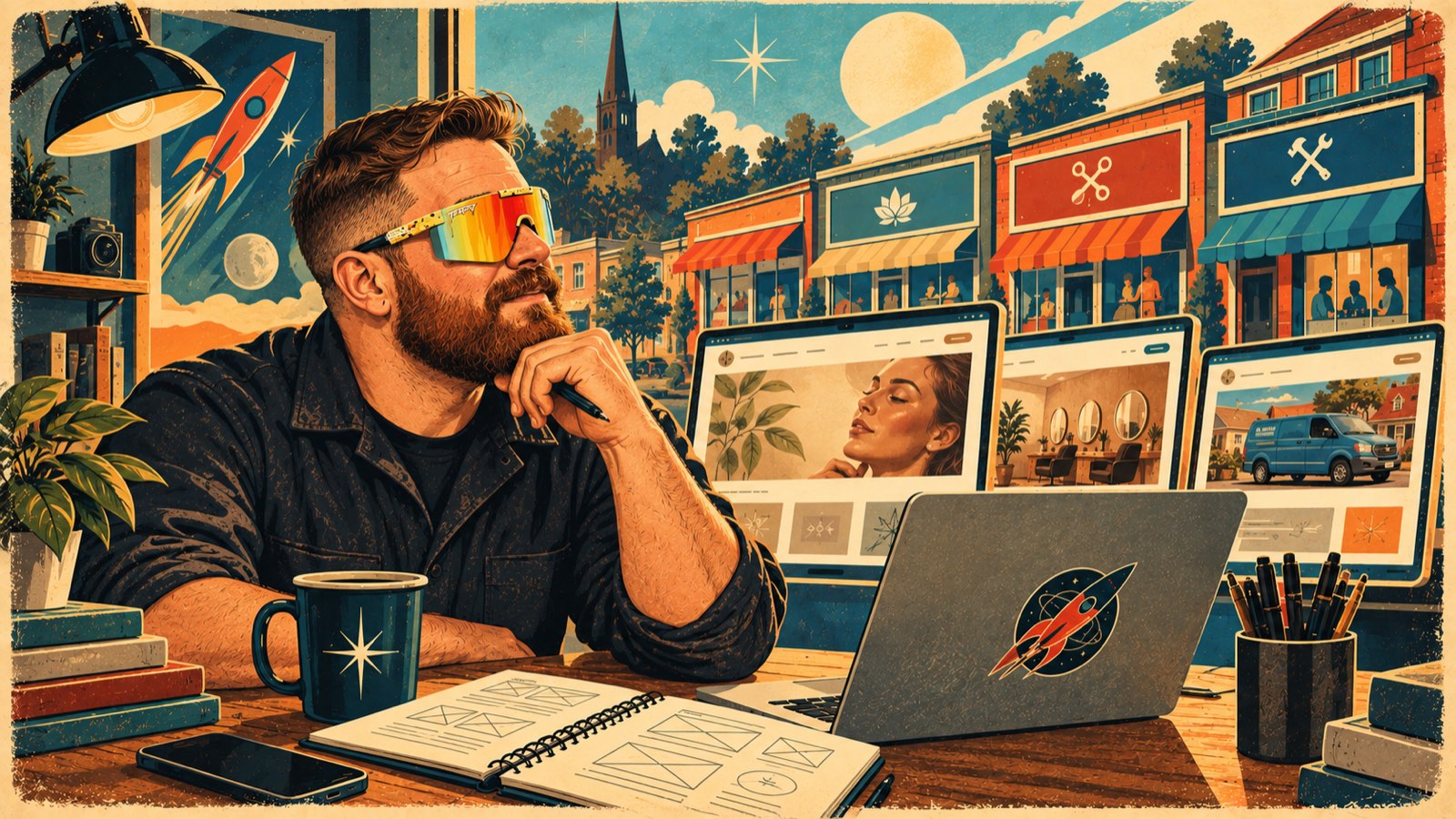
Can small businesses escape the template, subscription and sameness trap?
I've started noticing something about small-business websites.
A surprising number of them look almost identical.
Different logo.
Different photographs.
Different company name.
But underneath?
Same structure. Same enormous hero banner. Same collection of cards. Same stock phrases. Same booking button floating in the corner.
Same website wearing a different hat.
And increasingly, I've found myself wondering:
Why?
Small businesses are often the exact opposite of generic.
They're built around individuals. Personalities. Skills. Stories. Communities. Weird little details. Years of experience. Ways of doing things that have developed organically over time.
Then they go online and somehow all of that personality disappears.
They get squeezed into a template.
And quite often, they get a monthly subscription for the privilege.
That's something I want to explore.
The Subscription Treadmill
Modern website builders have done something genuinely brilliant.
They've made getting a business online incredibly accessible.
You don't necessarily need to understand hosting, HTML, CSS, databases or any of the other ingredients bubbling away underneath a website.
Pick a template.
Change the logo.
Upload some photographs.
Connect a domain.
Publish.
For plenty of businesses, that's exactly what they need.
But there's another side to it.
- Monthly website subscription.
- Booking-system subscription.
- Premium features.
- Additional storage.
- Email marketing.
- Analytics.
- E-commerce features.
- Plugins.
- Another upgrade because the feature you actually wanted isn't included in your current plan.
Individually, the numbers can look small.
But they keep coming.
Every month. Every year.
And the business may still be left with something it never really owns or controls in a meaningful way.
That got me thinking.
Could I build something different?
What If the Website Actually Belonged to the Business?
That's become the experiment behind this project.
Instead of starting with:
"Which website builder should we put you on?"
I want to start with:
"What does your business actually need?"
Maybe that's a relatively simple website.
Maybe it needs booking integration.
Maybe there's a gallery.
Maybe treatments or services need managing.
Maybe customers need a particular journey through the site.
Maybe there are things worth automating.
But importantly, I don't want to introduce a recurring service simply because that's what everyone else does.
If something can be built simply and sustainably, why bury it beneath unnecessary subscriptions?
I want to see how close I can get to building websites where the small business owns the thing we've created, while keeping the genuine ongoing costs as lean and transparent as possible.
Not free forever at any cost.
Not subscriptions are evil.
Just:
Stop Starting With Templates
The other half of the experiment is visual.
I don't want to build the same website twenty times.
If I build a website for a salon, I don't want to search:
"Salon website template."
Pick one.
Change pink to beige.
Job done.
I want to understand the actual salon.
What's it like when you walk through the door?
Who's behind it?
What do customers love about it?
Is it luxurious? Friendly? Bold? Minimal? Colourful? Calm? Quirky? Established? Modern?
The website should emerge from the personality of the business, not from whatever happens to be fashionable in web design that month.
A Website Should Feel Like Walking Through the Door
That's the standard I'm increasingly interested in.
Imagine you've never visited a particular business before.
You find its website.
You spend two minutes looking around.
Then you visit the physical business.
Do the two experiences belong together?
I think they should.
A beautiful little independent salon shouldn't necessarily have the same digital personality as a multinational beauty brand.
A spiritual wellness business shouldn't look like a private medical clinic because that's what the booking template happens to provide.
A traditional tradesperson doesn't automatically need the same black-and-yellow website as every other trade business within a 20-mile radius.
There should be fingerprints on these things.
Not literally.
That would be awful UX.
But personality.
Research the Business, Not Just the Competition
Competitor research still matters.
I want to know what other businesses in the same industry are doing.
What information customers expect.
What works.
What doesn't.
What booking journeys have become familiar.
What accessibility considerations matter.
But there's a danger in competitor research.
If you spend too long looking sideways, you eventually become everybody else.
Sometimes the best inspiration for a wellness website might not come from another wellness website.
It might come from an independent coffee shop.
A skincare brand.
An old botanical book.
An interior.
A record sleeve.
A particular period of design.
Anything that captures the personality we're trying to translate onto a screen.
That's much more interesting to me.
Building Around the Business
This also changes how I think about features.
I don't want to start with a giant checklist of things a modern website must have.
Start with the business.
What does the customer need to accomplish?
If it's a salon, perhaps the journey from discovering a treatment to booking it needs to be effortless.
For a wellness business, perhaps explaining the experience and building trust matters before asking someone to book.
A tradesperson might need to make requesting a quote ridiculously simple.
Another business might barely need functionality at all. It might simply need to explain what it does beautifully and make contacting the right person effortless.
The technology should disappear behind the business.
Modern Tools Have Made This Experiment Possible
This is also where modern development tools become incredibly interesting.
Historically, bespoke websites could be expensive because bespoke meant time.
A lot of time.
Design. Development. Testing. Content. Responsive layouts. Iterations. Maintenance.
Modern development tools have dramatically changed what one person can prototype and build.
That's what I want to explore.
Not whether a tool can churn out another generic landing page in thirty seconds.
It can.
We've got enough of those.
I'm interested in whether these tools can make individuality affordable again.
Can a tiny independent business get something that feels genuinely designed for them without needing the budget of a national company?
That's a far more interesting question.
Ownership Matters
There's also something philosophically appealing to me about giving somebody something they can call theirs.
- Here's your website.
- Here's how it works.
- Here's your content.
- Here's your domain.
- Here's what actually costs money to operate.
- Here's what doesn't.
No deliberately confusing bundle.
No mysterious Website Success Premium Plus package.
No holding the website hostage because somebody stopped paying a monthly design fee.
There will always be legitimate running costs.
Domains cost money.
Hosting can cost money.
Payment processors charge fees.
Some booking platforms, email providers, databases and specialist services charge for what they provide.
That's completely reasonable.
What I want to challenge is the idea that everything automatically needs to become another subscription.
Personality Is a Feature
We tend to talk about website features as functionality.
Booking. Search. Accounts. Payments. Forms. Galleries.
But I think personality is a feature too.
A website that actually represents a business can build familiarity before someone ever walks through the door.
The typography matters.
The photography matters.
The writing matters.
The little interactions matter.
The spacing matters.
Even the way a button says Book Now, Come and See Us, Start Your Journey or simply Get in Touch changes the voice.
None of those decisions is revolutionary on its own.
Together, they create identity.
This Isn't About Reinventing Web Design
I'm also not trying to make every website deliberately strange just for the sake of being different.
Sometimes conventional design exists because it works.
People expect navigation at the top.
They expect a logo to take them home.
They expect contact details to be easy to find.
They don't want to complete an escape room to discover your opening hours.
Good UX still matters.
Accessibility matters.
Performance matters.
SEO matters.
Security matters.
Mobile matters enormously.
The challenge is keeping those familiar foundations while giving the business enough freedom to actually feel like itself.
Different doesn't have to mean difficult.
The Case Study
That's what I'm going to document through these projects.
Not simply:
Before → After
I want each case study to explore the whole process:
What was the business paying before?
What did it actually need?
Which recurring costs were genuinely necessary?
Which could be removed?
What did its existing website communicate?
What does the business actually feel like?
How did that translate into colour, typography, imagery, writing and interaction?
What technology did I choose and why?
What does it cost to operate afterwards?
And, most importantly:
Does the finished website actually feel like the business it represents?
Small Business Shouldn't Mean Small Personality
That's ultimately what interests me about this project.
Independent businesses are interesting precisely because they're independent.
They're not corporations.
They don't have 14 layers of brand approval.
They're often built around someone's personality, reputation and years of work.
Their websites should celebrate that.
I want to see whether I can use modern development tools and a bit of obsessive research to build websites that are more personal, more distinctive and less dependent on unnecessary recurring costs.
Not websites designed to impress other web designers.
Websites designed to work for the businesses that own them.
And if I can hand a small business something that's faster, easier to use, cheaper to operate and feels unmistakably like them rather than everybody else?
That's a project worth exploring.