The American Electrician: Another Reason I'm Obsessed With Good Tools
Watching the American Electrician has a dangerous side effect. You start wondering whether there's a beautifully engineered German version of every tool you own.
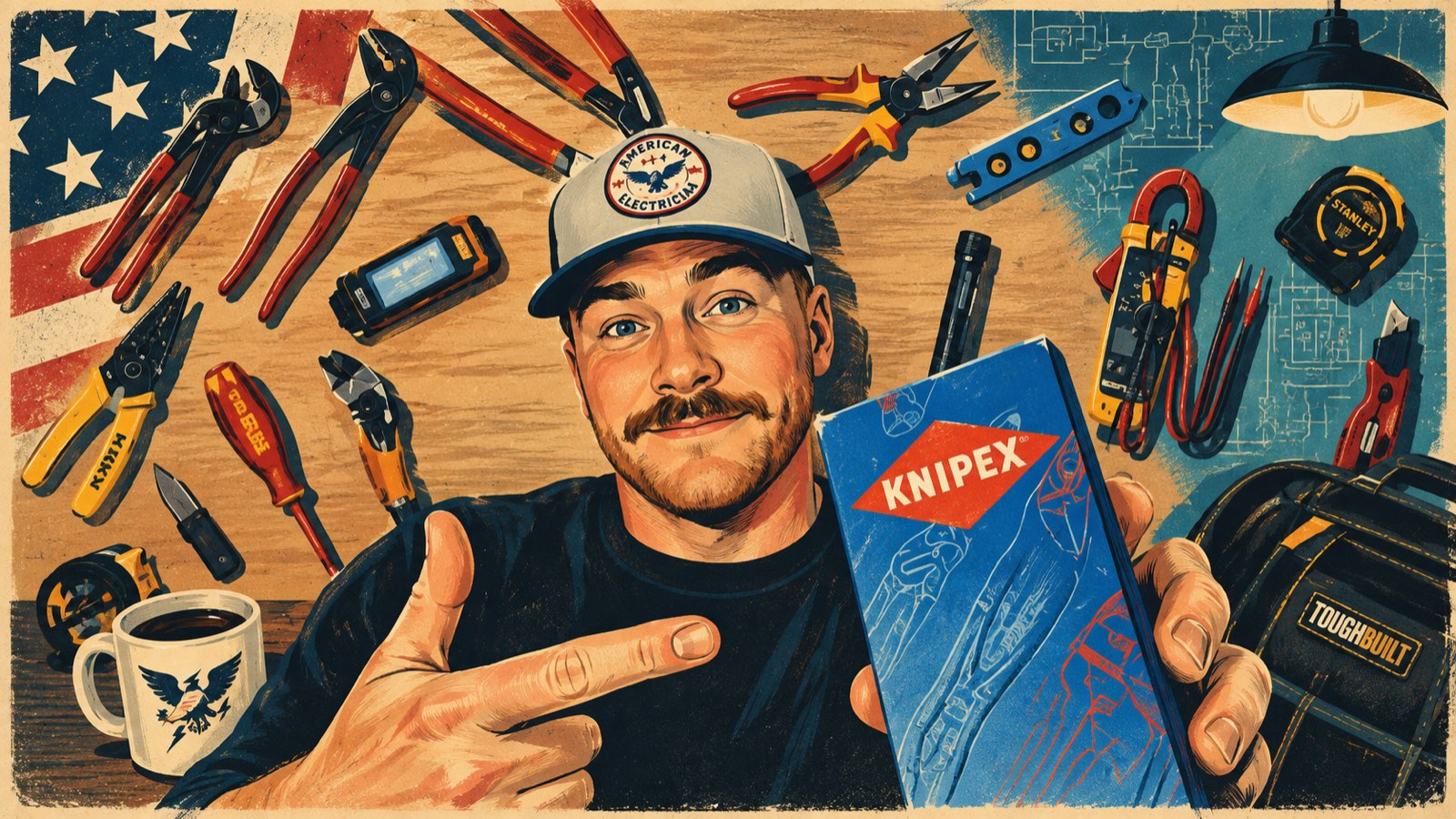
There's a dangerous side effect to watching the American Electrician: you start looking at perfectly functional tools you already own and wondering whether there's a beautifully engineered German version that does the job better.
I've written before about the people who have influenced the way I approach making, engineering and workmanship. Adam Savage helped fuel my curiosity. John Malecki and his team reinforced the idea of taking pride in the work itself.
Then there's American Electrician on YouTube.
And he's partly responsible for another obsession of mine:
Really, really good tools.
Not tools because they look impressive sitting in a toolbox. Tools because somebody has clearly spent time thinking about the person who has to use them eight hours a day.
"If You Care About Your Craft…"
There's a quote attributed to Spencer West, the creator behind American Electrician, that pretty much encapsulates why his content resonates with me:
"If you care about your craft, then you care about your tools."
That line appeared in an Acme Tools feature about his advice for apprentices, and it sums up something I've gradually come to appreciate in my own career.
Good tools aren't about showing off.
They're part of taking your work seriously.
If you spend your working life diagnosing, repairing, installing, adjusting, cutting, fastening and generally persuading machines to behave themselves, the things in your hands matter.
The Tiny Details Matter
One of the things I enjoy about American Electrician is the attention given to the details that can make one tool noticeably better than another.
Not simply:
"These pliers are good."
But why are they good?
What's the geometry of the jaws like?
How easily do they adjust?
How comfortable are they after repeated use?
Can they get into a tighter space?
Does the design reduce the number of tools you need to carry?
Will they damage the fastener?
Those details can sound ridiculously insignificant until you're the person using that tool hundreds or thousands of times.
His discussions of Knipex are a perfect example. He's highlighted everything from the Cobra and TwinGrip to installation pliers, CoBolt cutters and the Pliers Wrench, looking at details such as jaw profiles, leverage, adjustment mechanisms and ergonomics.
And this is where the rot sets in.
You start noticing those details yourself.
Hello, Knipex…
American Electrician has definitely contributed to my appreciation of Knipex.
And that's a financially dangerous appreciation to develop.
A pair of pliers stops being just a pair of pliers when you begin noticing how the jaws engage, how much leverage you're getting, how the adjustment works and how much better a properly designed tool feels in your hand.
The Knipex Pliers Wrench is a fantastic example of the kind of tool that appeals to me.
At first glance, it's simple.
Then you look closer.
Parallel smooth jaws. Push-button adjustment. Huge mechanical advantage. The ability to work on finished fittings without attacking them with teeth. The ability to reposition around a fastener in confined spaces. American Electrician has specifically highlighted those characteristics when explaining why he rates the design so highly.
That's engineering applied to something wonderfully mundane.
And I love that.
Wera, Knipex and the Tool Rabbit Hole
It's also part of why my own tool collection has increasingly filled with names like Wera and Knipex.
I use my tools every day as a field service engineer, so I've become incredibly appreciative of little pieces of thoughtful design.
My Wera Kraftform screwdrivers are a perfect example.
The shape of the handle.
The grip.
The Lasertip biting into a screw rather than immediately trying to escape.
The colour coding on my Wera Hex-Plus keys.
The holding functions.
The reassuringly industrial nature of a proper through-tang Chiseldriver.
None of those features fundamentally changes what a screwdriver or hex key is.
They just make the tool nicer and more effective to use.
A Tool Doesn't Have to Be Complicated to Be Clever
That's probably my favourite part of tool design.
Some of the best engineering is almost invisible.
Take a pair of pliers.
Humans have been making variations of them for centuries.
Surely we've finished designing pliers by now?
Apparently not.
Change the pivot position.
Alter the jaw geometry.
Change the direction of the teeth.
Improve the handle.
Add a clever adjustment mechanism.
Reduce the head thickness.
Suddenly you've taken one of humanity's simplest tools and made it noticeably better.
American Electrician's videos scratch exactly that part of my brain.
It's not simply buy this shiny thing.
It's looking at why one design works.
And that's what gets me.
Buy Once, Cry Once
I've gradually adopted a fairly simple philosophy with the tools I rely on professionally:
That doesn't mean the most expensive tool automatically wins.
Price and quality aren't the same thing.
Sometimes an inexpensive tool is brilliant. Sometimes an expensive one is unnecessary. Sometimes the weird little specialist tool you thought was ridiculous becomes the thing you reach for constantly.
American Electrician regularly explores exactly that territory. His channel covers electrical how-to content alongside tool bags, hand tools and power tools, and his recommendations often get into the specific design decisions that separate an ordinary tool from a genuinely useful one.
That's far more interesting to me than a logo.
What problem does this solve?
My Van Is Basically a Giant Toolbox Now
This mentality has inevitably spilled into my own working life.
Open the back of my van and you'll find the evidence.
Wera screwdrivers and hex keys. Specialist bits. Lubricants. Consumables. Electrical tools. Diagnostic equipment. Different tools for annoyingly specific jobs.
And yes, occasionally a tool whose purpose could probably be achieved by another tool I already own.
But that's beside the point.
Probably.
What I've realised is that I genuinely enjoy building a toolkit around the work I do.
Every tool earns its place.
Some make a job faster.
Some make it safer.
Some give a better finish.
Some save a return visit.
And occasionally you find one that makes you wonder how you ever tolerated doing the job without it.
Tools Are Part of the Craft
That's ultimately why channels like American Electrician resonate with me.
I don't think my obsession is really about owning things.
It's about craft.
I like objects that have been designed by people who understand the job they're supposed to perform.
I like picking something up and discovering a tiny feature that makes me think:
That's clever.
I like maintaining my tools.
Organising them.
Learning better ways to use them.
And I like the feeling of arriving at a job knowing that somewhere in the van is probably exactly the thing I need to solve the problem in front of me.
The American Electrician has certainly encouraged that mindset.
He's also responsible for me knowing far too much about pliers.
And probably spending considerably more money on them than any reasonable human being should.
But when you're using tools every day, there's something enormously satisfying about using ones that have been designed and made properly.