Wera Multicolour L-Key Sets
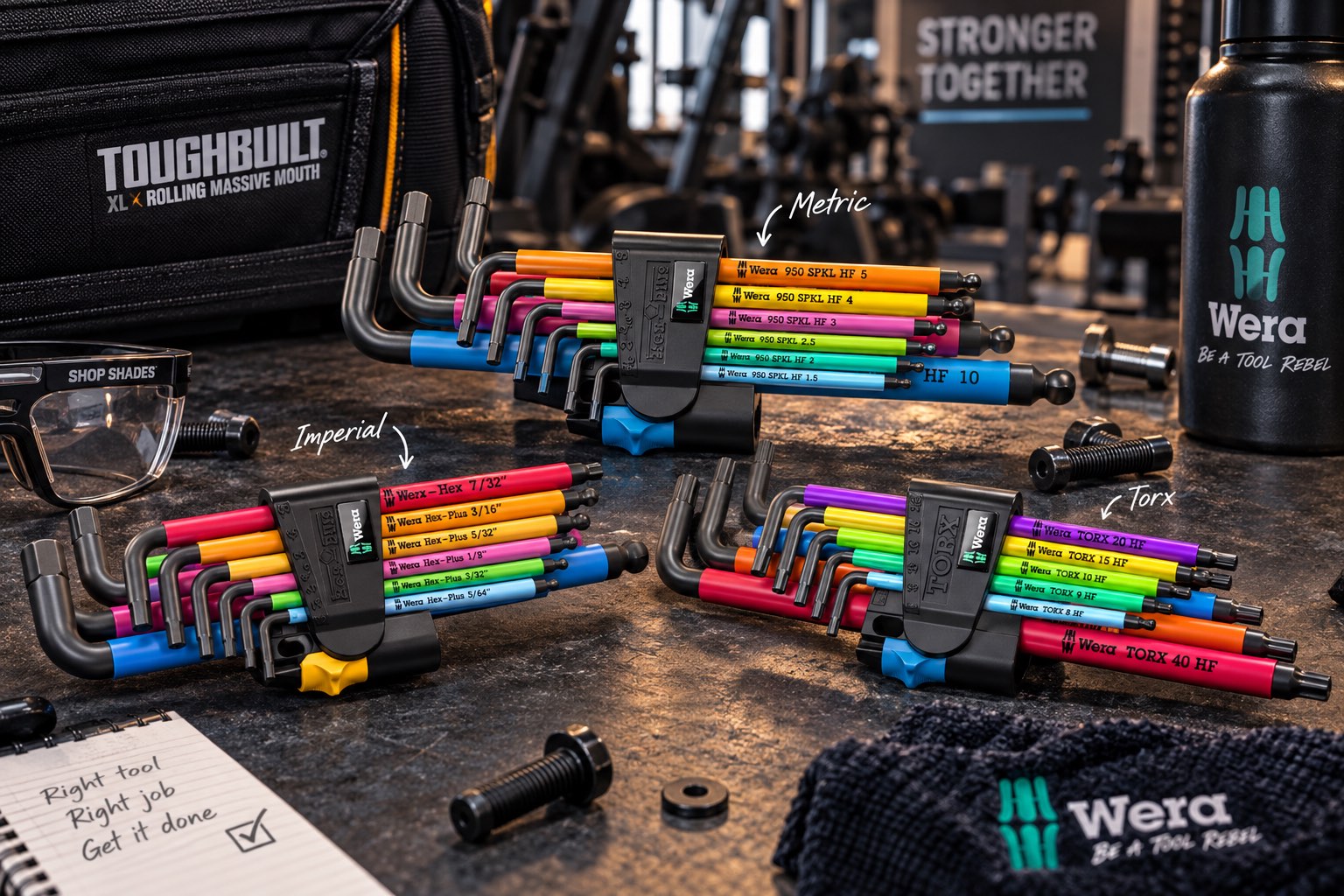
The best hex keys I have ever used. I started with one set and now carry metric, imperial and TORX.
The best hex keys I've ever used
There are some tools where I don't think there's much point overcomplicating the review.
These are the best hex keys I've ever used.
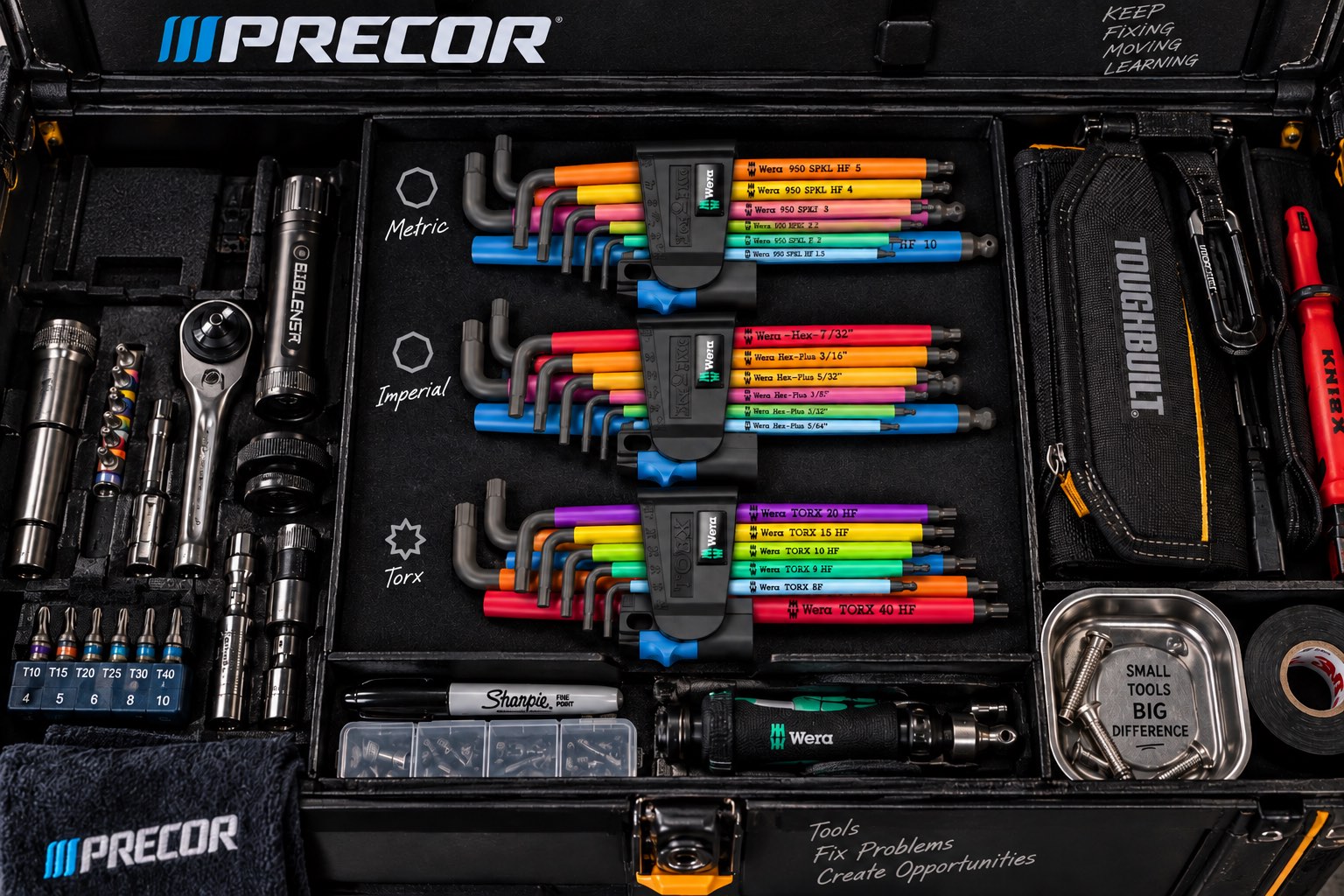
My main set is the Wera 950/9 Hex-Plus Multicolour HF 1 metric set, but I like them enough that I've gone all in and now carry all three versions in my tool kit: metric Hex-Plus, imperial Hex-Plus and TORX.
That's probably a better review than anything written on the packaging.
They're beautifully made, comfortable to use and have some genuinely clever features, but weirdly, one of my favourite things about them is also one of the simplest.
They're colourful.
And once you've worked with colour-coded keys every day, going back to a row of identical black hex keys feels strangely prehistoric.
Why I bought Wera
Hex keys are something I use constantly.
Working on commercial gym equipment means I'm forever removing covers, adjusting components, stripping assemblies down and putting them back together again.
They're not an occasional tool that sits at the bottom of my bag waiting for a very specific job.
I use them every day.
I'd used plenty of different hex keys before buying the Wera sets and, ultimately, they all did roughly the same thing.
Then I tried these.
The difference in quality was immediately noticeable.
They feel substantial in your hand, the individual sleeves give you a good grip and everything about them feels properly engineered.
But Wera also seems to have looked at the humble hex key and asked:
How can we make this less annoying?
Quite a lot, apparently.
The colour coding is brilliant 🌈
This is easily one of my favourite features.
Wera calls it their Take it easy Tool Finder. Each key is colour coded according to its size, with the size also clearly marked on the sleeve.
That means after you've used them for a while, you start recognising the colours.
Instead of picking up a key, checking the size, putting it back, trying another one, discovering that's wrong too and questioning all the decisions that brought you to this particular bolt…
You start thinking:
It sounds like a tiny improvement.
When you're doing it repeatedly throughout a working day, it isn't.
There's another benefit I didn't really think about when I bought them
Gym floors are dark.
Black rubber flooring. Dark carpet. Black equipment. Dark areas underneath machines.
And what colour are most traditional hex keys?
Black.
Drop one and you've just started a very boring game of hide-and-seek.
The bright Wera sleeves make these so much easier to spot on the floor.
If I've put a few keys down beside the machine while I'm working, I can actually see them.
Likewise, if one rolls away or gets left underneath something, that flash of yellow, green, blue, orange or pink stands out against a black gym floor.
It's probably not something Wera's engineering department had "Lewis crawling around underneath a treadmill" written on the whiteboard for, but it's genuinely useful for me.
Hex-Plus is more than clever branding
There's some proper engineering going on at the business end too.
Wera's Hex-Plus profile is designed to increase the contact area between the tool and the screw rather than concentrating the load onto small areas of the socket.
Wera says this reduces the notching effect that can damage and eventually round out socket-head screws, while allowing up to 20% more torque to be applied. Importantly, Hex-Plus still works with standard hex socket screws.
For me, the important bit is much simpler:
I want to undo the bolt, not turn its hexagonal socket into a circle.
Particularly when I'm working on equipment that's been serviced multiple times before me, anything that gives me a better chance of getting a stubborn fastener out without damaging it gets my vote.
The holding function is fantastic
My metric set also has Wera's HF holding function.
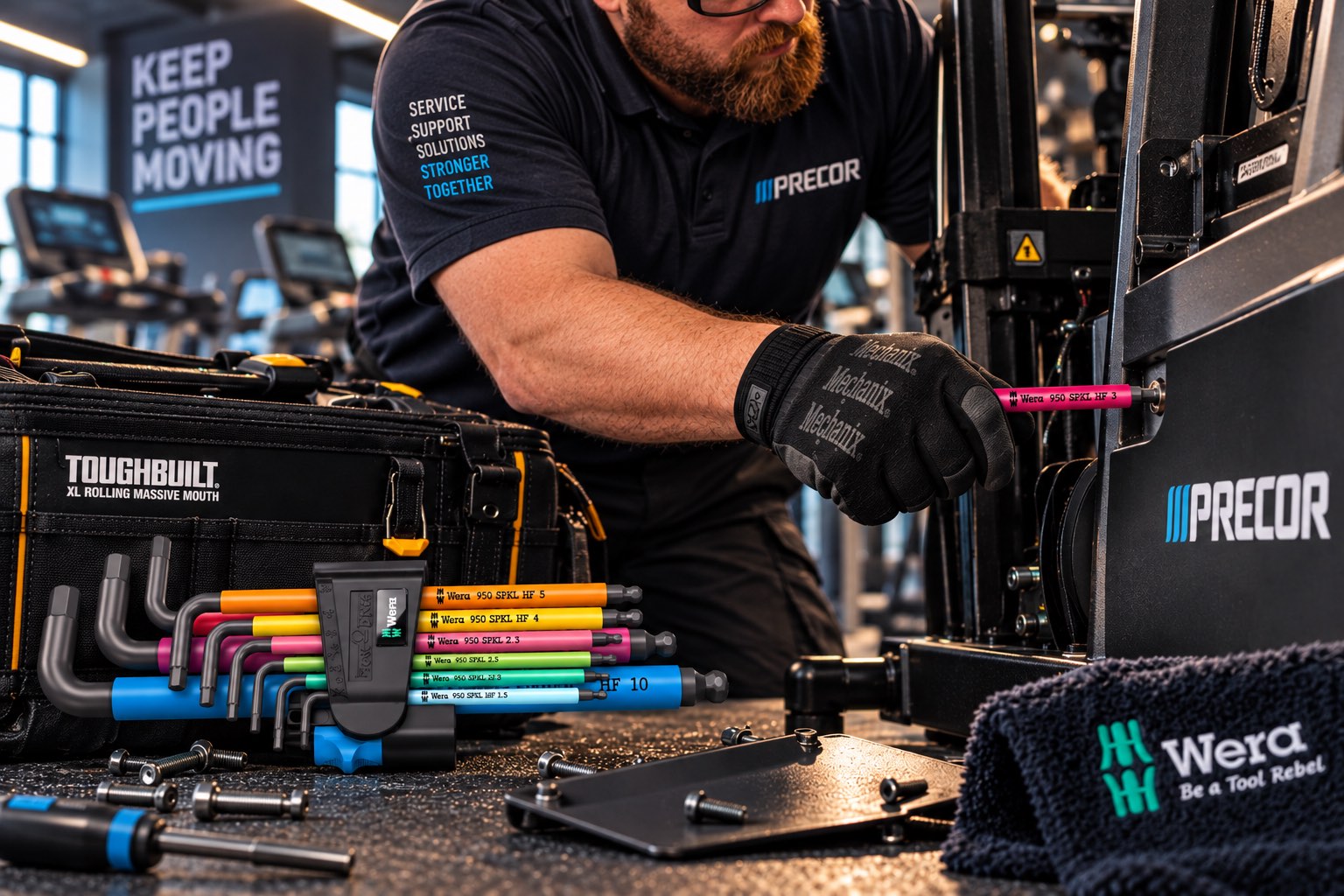
There's a flexible locking ball that helps hold a hex socket screw onto the end of the key.
Again, that sounds like a relatively minor feature until you're actually working somewhere awkward.
Gym equipment has plenty of places where you're reaching through frames, behind covers or into spaces where you can't get your other hand anywhere near the screw.
Being able to put the screw onto the key and have it stay there while I guide it into position is genuinely useful.
It also reduces the opportunity for that wonderful moment where you hear:
tink… tink… tink…
…and watch the screw disappear somewhere into the machine.
The ball end gets used constantly too
The long arm has a ballpoint profile, allowing the key to engage the fastener while the tool itself is sitting at an angle.
That's another feature that suits my work perfectly.
Sometimes you're dealing with a bolt where getting perfectly straight access simply isn't possible.
Being able to approach it at an angle can be the difference between getting the job done normally and inventing an entirely new vocabulary while trying to get your hand into a ridiculous position.
They feel really good in your hand
Rather than leaving the keys as bare metal, Wera uses easy-to-grip thermoplastic sleeves.
They're comfortable, give you a decent grip and make the individual sizes much easier to identify.
Wera also says the sleeves remain comfortable at low temperatures, while the circular construction is designed to reduce strain during longer periods of use.
For me, it's another one of those things that separates them from a cheap set.
You can absolutely buy cheaper hex keys that will turn the same bolt.
But when you're using them constantly, these little improvements start adding up.
I've got all three sets
This is where my toolbox gets particularly colourful.
Alongside the metric set, I also carry the Wera 950/9 Hex-Plus Multicolour Imperial set.
The imperial set gives me the same general design, colour coding, comfortable sleeves, Hex-Plus profile and ball-ended long arms, but covers imperial fasteners.
And then there's my Wera 967/9 TX XL Multicolour HF TORX set.
These are extra-long TORX L-keys, again with Wera's colour-coded Tool Finder system and a holding function on the long arm. They also use Wera's BlackLaser surface treatment for corrosion protection and durability.
So between the three holders I've got:
Metric Hex-Plus. Imperial Hex-Plus. TORX.
It's a decent chunk of space in the tool bag, but considering how often I use them, they've absolutely earned it.
The holders are good too
This sounds insignificant until you've owned a hex-key holder that refuses to give you the key you want.
The Wera clips securely hold the individual keys while still making them straightforward to remove. They're made from wear-resistant material, so they're intended to survive being opened, closed and thrown around in a tool bag repeatedly.
I particularly like being able to look at the holder and immediately see if something is missing.
And with all those colours, a missing key tends to leave a fairly obvious gap.
That's handy when I'm packing everything away at the end of a repair.
Are they overkill?
For assembling an IKEA wardrobe once every three years?
Probably.
You can buy a perfectly functional set of hex keys for considerably less money.
But that's not how I use mine.
These are everyday tools for me.
When something is coming in and out of my tool bag constantly, I don't mind spending more for something that's better designed, more comfortable and easier to use.
The colour coding saves time.
The sleeves make them comfortable.
The ball ends help with awkward access.
The holding function helps in confined spaces.
Hex-Plus helps reduce the chances of damaging fasteners.
And they're incredibly well made.
None of those things individually revolutionises the humble hex key.
Put them all together, though, and you get a tool that's noticeably nicer to work with.
Why they're staying in my kit
There isn't really much suspense here.
They're not going anywhere.
In fact, I started with one Wera set and ended up owning metric, imperial and TORX.
That probably tells you everything you need to know.
They're some of the most frequently used tools in my bag and they're one of those purchases where, having used them for a while, I wouldn't want to go back to ordinary hex keys.
The colour coding alone has completely won me over.
Add the quality, grip, Hex-Plus profile, ball ends and holding function and you've got a really well thought-out set of tools.
Would I buy them again?
Immediately.
If my metric set disappeared tomorrow, I'd replace it with exactly the same set.
And then I'd spend the rest of the day looking underneath every treadmill I'd worked on because those things definitely didn't just vanish on their own.
My verdict
- Build quality ★★★★★
- Comfort ★★★★★
- Colour coding ★★★★★
- Ease of finding the right size ★★★★★
- Working in awkward spaces ★★★★★
- Visibility on dark gym floors ★★★★★
- Everyday usefulness ★★★★★
Would I buy them again? Without question.
Best thing: The colour coding. It's such a simple idea, but once you've got used to it, ordinary hex keys feel unnecessarily difficult.
Unexpected bonus: Drop one onto a black gym floor and you've actually got a fighting chance of finding it.
WHERE TO GET THEM