NetworkChuck: Curiosity, Networking and Learning in Public
Chuck Keith treats networking as something you can build, break and explore rather than memorise. He is one of the reasons I started chasing the CCNA, and a large part of why this site is a workshop rather than a CV.
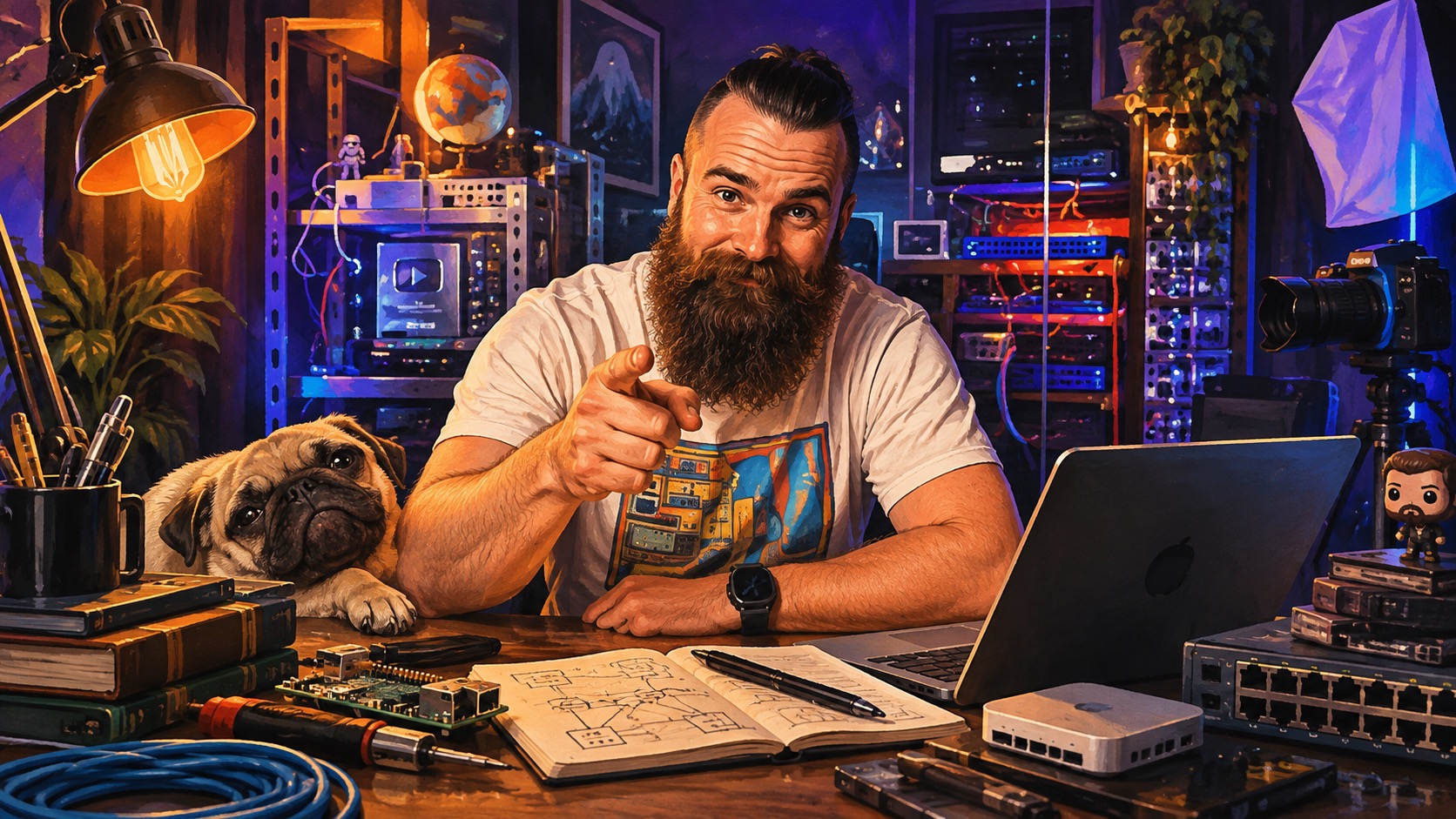
Chuck Keith · Network Engineer · IT Educator · Creator
There are people who teach you a particular skill, and then there are people who change the way you approach learning altogether.
For me, Chuck Keith, better known as NetworkChuck, falls into the second category.
I discovered NetworkChuck through my growing interest in networking, Cisco and the CCNA, but what kept me watching wasn't simply the information. It was his attitude towards technology.
Here was someone treating networking not as a dry collection of protocols, subnet masks and certification objectives, but as something you could explore.
Build a lab.
Break something.
Spin up a server.
Install Linux.
Configure a switch.
Try something ridiculous with a Raspberry Pi simply because you want to know whether it'll work.
That approach immediately made sense to me.
From IT Job to NetworkChuck
Chuck's route into technology is part of what makes his story interesting to me.
He didn't build his career around a traditional four-year computer science degree. His own Academy describes his career as one built through self-study, experience and professional certifications. He worked his way into networking and earned certifications including Cisco's CCNA and CCNA Voice alongside CompTIA Security+. He later added qualifications covering Linux, Azure and Cisco DevNet.
His relationship with technical training came full circle too.
Chuck has spoken about learning networking through CBT Nuggets and particularly being inspired by trainer Jeremy Cioara. Years later, Chuck became a CBT Nuggets trainer himself.
In 2014 he started the NetworkChuck YouTube channel.
The original idea wasn't simply to become a technology YouTuber. Chuck has explained that he had been inspired by another creator documenting his own Cisco certification journey. Chuck realised there were very few people talking openly about what it was actually like to build a career in IT.
So he picked up a camera.
One of his earliest NetworkChuck videos was filmed in an IT closet at work while he was configuring Cisco firewalls.
That detail probably explains a large part of why his work resonates with me.
It wasn't somebody standing outside the industry explaining what an engineer might do.
He was doing the work and documenting the journey.
Technology You Can Touch
One of the things NetworkChuck does particularly well is make technology feel tangible.
Networking can become incredibly abstract when it's reduced to diagrams.
Packets move through boxes.
Addresses appear on screens.
Protocols negotiate with other protocols.
Everything works somewhere behind the curtain.
Chuck pulls the curtain away.
His videos regularly involve actual switches, routers, servers, virtual machines, terminals, Raspberry Pis and home labs. Networking becomes something you can physically build and experiment with.
That's much closer to how I naturally learn.
I've spent most of my working life around things that can be diagnosed, repaired, configured or improved. Whether that was equipment in people's homes during my years at Sky, televisions, or now commercial fitness equipment with Precor, I've always learned best by getting close to the thing itself.
Look at it.
Understand what it is supposed to do.
Work out why it isn't doing it.
Fix it.
Networking scratches exactly the same itch.
The tools are different, but the thought process is remarkably familiar.
The CCNA
NetworkChuck has been one of the influences behind my own interest in the Cisco Certified Network Associate qualification, the CCNA.
For years networking had been something sitting slightly behind the work I was already doing.
IP addresses.
Routers.
Switches.
Wi-Fi.
Connected devices.
Remote diagnostics.
Servers.
Cloud services.
Individually, I understood pieces of it.
CCNA offered something different: the opportunity to understand the system underneath those pieces.
NetworkChuck helped make that prospect exciting rather than intimidating.
His approach to certification has never felt like simply memorising enough information to pass an exam. The interesting part is understanding why the network behaves the way it does and then proving that understanding by actually building something.
That distinction matters to me.
I don't particularly want a collection of letters after my name for the sake of collecting letters.
I want to know more.
The qualification provides the destination. Curiosity provides the reason for travelling there.
The Lab Mentality
Perhaps the biggest NetworkChuck influence on me is the idea of the lab.
A lab doesn't need to be a pristine room full of enterprise equipment.
It can be Packet Tracer.
A Raspberry Pi.
An old computer.
A virtual machine.
A small switch.
A terminal window.
Or simply an idea you haven't tried before.
The important part is experimentation.
That idea stretches far beyond networking for me.
A surprising amount of what I build begins as my version of a lab.
The Field Service app started because I wondered what a field-service system would look like if it were designed around the engineer actually standing in the plant room.
My stock-management ideas came from looking at the parts in a service van and asking whether the information surrounding them could be smarter.
The employment verification project began with a simple question about whether a QR code could make proving employment easier.
The netball systems I've built came from seeing processes around coaching and clubs that could be improved.
Even this website is effectively a permanent lab.
None of those things required someone to give me permission to investigate them.
They started with:
I wonder if I could build that.
That is very NetworkChuck.
You Don't Have to Stay in Your Lane
Another thing I enjoy about Chuck's work is how freely he moves between subjects.
Networking leads into Linux.
Linux leads into servers.
Servers lead into containers.
Containers lead into cloud computing.
Networking leads into cybersecurity.
Cybersecurity leads into Python.
Python leads into automation.
Then suddenly there's a Raspberry Pi sitting on the desk and an entirely different experiment has begun.
It reflects something I've gradually realised about myself.
I've never been particularly interested in staying inside one neatly labelled box either.
I'm a field service engineer, but I'm interested in networking.
I'm learning networking, but I'm interested in coding.
I build software ideas, but I still love physical tools.
I build websites.
I coach netball.
I work on stock systems.
I take photographs.
I design things.
I pull equipment apart.
I write about the things I've learned.
For a long time those could have looked like unrelated interests.
Creators such as NetworkChuck helped me realise that they don't necessarily need to be.
The connecting thread is curiosity.
Learning in Public
There's another NetworkChuck idea that has increasingly influenced this website.
You don't have to wait until you're an expert before you're allowed to talk about something.
You can document the process of becoming better.
NetworkChuck itself began that way.
Chuck wasn't presenting himself as the person who had already reached the end of IT. He was documenting his career, certifications and experiments while he was progressing through them.
That changes the relationship between learning and creating.
Instead of:
Learn → become expert → talk about it
it can become:
Learn → build → document → share → learn more.
That's increasingly what LewisCleveland.uk has become for me.
It isn't supposed to present a polished version of someone who has finished learning.
Quite the opposite.
It's a workshop.
Some things on here are finished projects. Some are experiments. Some are notes from work. Some are things I'm studying. Some are ideas sitting on the bench waiting for another evening.
The process is part of the story.
Making Technical Things Human
NetworkChuck also showed me something important about communication.
Technical information doesn't have to look corporate to be credible.
You can have personality.
You can get excited.
You can have a workshop full of equipment.
You can obsess over coffee.
You can make jokes.
You can build a recognisable visual identity.
And underneath all of that, the technical information can still be serious.
That's influenced how I think about presenting my own work.
I don't want this website to feel like an online CV where every sentence has been scrubbed clean until it sounds like it came from a corporate template.
I want the personality left in.
The tools matter.
The stories matter.
The mistakes matter.
The strange experiments matter.
The reason I built something matters just as much as the technology I used to build it.
Curiosity as a Career Skill
One of my favourite things about technology is that nobody ever really reaches the end of it.
There is always another layer.
Learn how a device connects to a network and eventually you'll wonder how the switch knows where to send the frame.
Learn switching and eventually you'll reach routing.
Learn routing and you'll encounter security.
Learn security and you'll find Linux.
Learn Linux and you'll discover scripting.
Learn scripting and you'll start automating things.
Then somebody changes the technology and half the landscape moves again.
You can either find that exhausting or fascinating.
I choose fascinating.
NetworkChuck helped reinforce that attitude.
The goal isn't to know everything.
It's to remain interested enough to keep discovering the next thing.
From Field Engineer to Network Engineer Thinking
I'm not trying to become NetworkChuck.
And I'm not trying to abandon field service and suddenly reinvent myself as somebody who spends every waking hour inside a terminal.
What I'm interested in is adding another layer to the engineer I already am.
Modern field service increasingly overlaps with IT.
The equipment I work with doesn't exist in isolation anymore. Machines connect to networks. Consoles communicate with servers. Content is delivered digitally. Software, firmware, infrastructure and physical hardware increasingly meet inside the same product.
That makes networking knowledge useful far beyond a traditional network-engineering job.
Understanding the physical machine is useful.
Understanding the software is useful.
Understanding the network connecting everything together is even more useful.
That's where I see my CCNA journey fitting.
Not replacing what I already know.
Extending it.
The Influence
NetworkChuck's biggest influence on me isn't a particular Cisco command or Linux distribution.
It's permission to follow the rabbit holes.
To learn something because it interests me.
To build a lab before I completely understand what I'm doing.
To document what I discover.
To treat certifications as milestones rather than destinations.
To allow networking, engineering, coding, web development and physical making to overlap.
And perhaps most importantly, to remember that technology should still be fun.
There is something wonderful about reaching the point where something that previously looked like incomprehensible technical noise suddenly makes sense.
A network diagram becomes understandable.
A terminal command produces the result you expected.
Two devices finally communicate.
A program runs.
A system you designed actually works.
That little moment of "I understand this now" is addictive.
NetworkChuck has built an entire career around encouraging people to chase those moments.
I'm still chasing them too.
There are just considerably more browser tabs open now.
PART OF THIS STORY
- Before I Had a Toolbox, I Had WoodleyThoughts · 20.09.26
- Working Towards My CCNA 200-301Networking · 13.09.26