The Right Bolt, Every Time
Why knowing who to ask can be just as important as knowing the answer.
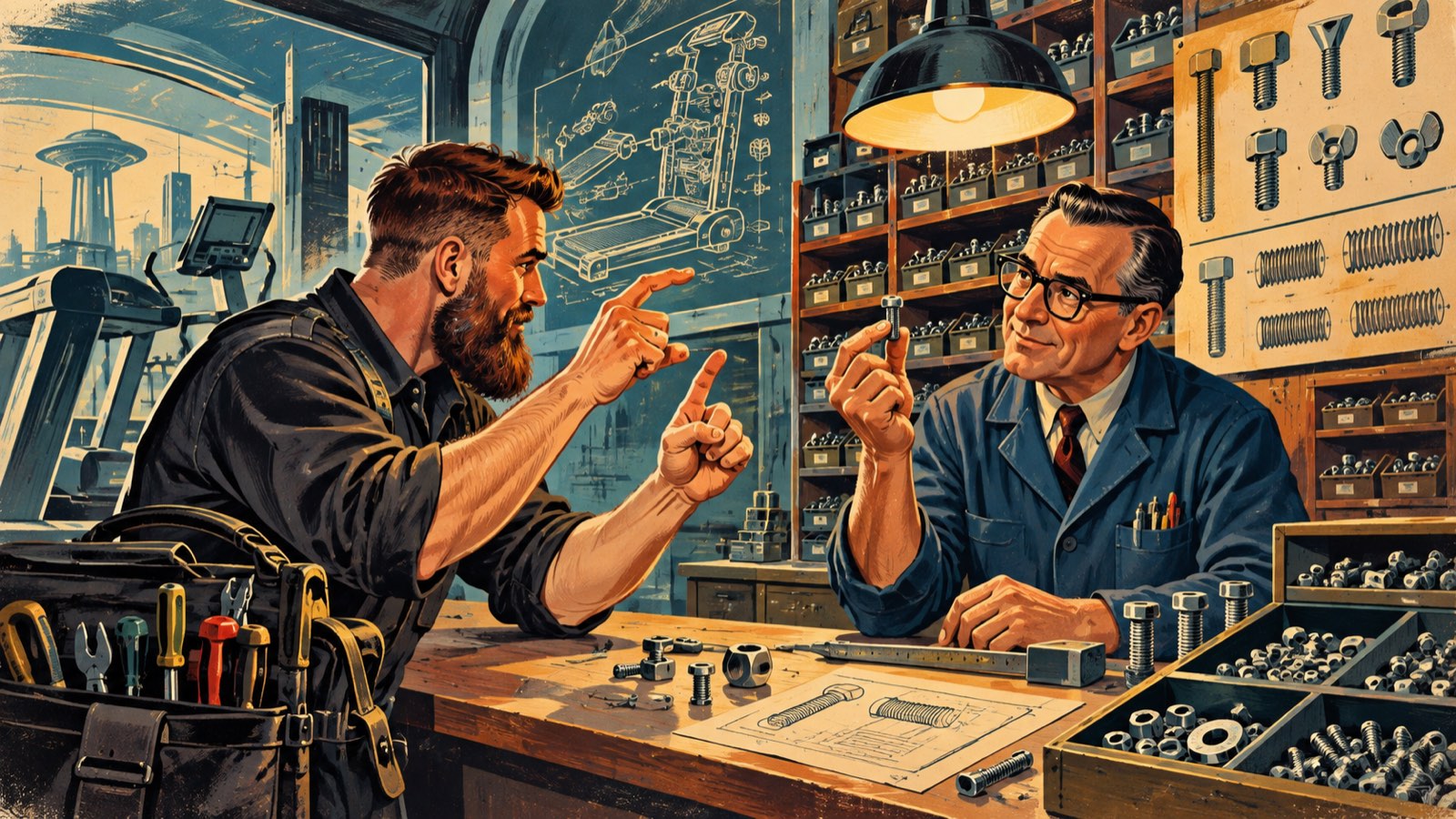
Why knowing who to ask can be just as important as knowing the answer
There are parts of engineering I'm confident with. Diagnostics, fault finding, taking equipment apart, working out why something has failed and figuring out how to put it right.
Then there are bolts.
My knowledge of bolts has, at times, ranged somewhere between "that looks bolty" and "yeah, about this long" while holding my fingers apart and hoping the person behind the counter can somehow translate that into an actual engineering specification.
Fortunately, I know exactly where to go.
The value of a proper local supplier
One thing I've learned during my career as a field service engineer is that you don't have to know absolutely everything.
You need to understand your equipment, develop your skills and keep learning, but you also need to know when somebody else knows considerably more about something than you do.
For fasteners, that place has been Boka Bolt Supplies.
I can walk in with a bolt, a vague description, some questionable hand gestures or an explanation of where it came from, and somehow the team manages to decipher what I'm talking about.
Sometimes I know exactly what I need.
Other times it's effectively:
It's about this long, looks like this, goes into this bit of a machine and the original has disappeared.
Yet somehow I walk back out with the right thing.
That expertise is easy to underestimate.
There's a lot hiding inside a "bolt"
Before working more closely with machinery, a bolt was basically a bolt to me.
Then you start encountering different diameters, pitches, lengths, head types, grades, metric and imperial threads, UNC, UNF and all the other tiny details that determine whether something fits perfectly or becomes a very expensive way of discovering that nearly right is still wrong.
In field service, those details matter.
A missing or damaged fastener can be the difference between finishing a repair there and then or having equipment remain unavailable while the correct part is identified and sourced.
Having somebody who can look at what you've brought in and quickly identify what you actually need is incredibly valuable.
Good engineering includes knowing what you don't know
There's another reason I wanted to turn my original LinkedIn post into something longer.
I think there can sometimes be pressure in technical jobs to appear as though you know everything.
I don't.
And I'm perfectly comfortable saying that.
If I don't understand something, I'll ask.
If somebody knows more about a subject than I do, I'll listen.
If I need to stand at a trade counter making increasingly elaborate hand gestures to describe a bolt, apparently I'll do that too.
That willingness to ask questions has probably taught me more throughout my career than pretending I already knew the answer ever could.
The people behind specialist trade counters have often spent years building knowledge that you simply cannot replace with a five-minute internet search. They know the products, they've seen the strange requests before, and quite often they can spot the solution before you've finished explaining the problem.
The people behind the parts
That was really the point of my LinkedIn post.
It wasn't actually about bolts.
It was about people.
Field service might look like one engineer arriving at a site and fixing a machine, but there's an entire network behind every successful repair: technical support, parts teams, coordinators, manufacturers, suppliers and the people at local businesses who help when something unexpected crops up.
Those relationships matter.
And when they manage to do that without judging your highly sophisticated "about this long" measurement system, they deserve some recognition.
So, to the team at Boka Bolt Supplies: thank you for the knowledge, the patience and for repeatedly translating my questionable descriptions into exactly the fastener I actually need.
If patience were a fastener, they'd stock it by the pallet load. 🔩👏
bokabolts.co.uk